Act 38-2026 (Ley 38-2026) keeps the Puerto Rico Act 60 investor decree alive through 2055, but it removes the 0 percent deal that made the program famous. New applicants who miss the December 31, 2026 deadline will pay a 4 percent tax rate on capital gains, dividends, and interest, plus face stricter residency and home-ownership rules.
This article walks through the concrete costs and trade-offs for Act 60 applicants going forward, so you can make a clear-headed decision about whether the post-2026 structure still works for your situation.
Key Takeaways
Applications filed on or before December 31, 2026, lock in the 0 percent Act 60 tax rate through December 31, 2035.
Applications filed on or after January 1, 2027, face a 4 percent fixed rate on capital gains, dividends, and interest, locked in through 2055.
Post-2026 applicants must prove six years of non-Puerto Rico residency before applying.
New applicants must own their primary residence directly, jointly with a spouse, or through a qualifying grantor trust, and the deed must be registered within 2 years.
Existing Act 60 decree holders keep their current terms and are not affected by the new rates.
What Ley 38-2026 Actually Changes for Act 60 Applicants
Ley 38-2026, signed into law by Governor Jenniffer González-Colón on March 10, 2026, does two things at once. It extends the Puerto Rico resident individual investor program, and it raises the cost of entry for anyone who waits. The law preserves the zero-rate structure for applications filed on or before December 31, 2026, and replaces it with a 4 percent fixed preferential rate for applications filed after that date. That shift affects every major income stream the program covers, including Puerto Rico capital gains tax, dividends, and interest income.
The six-year nonresidency requirement is the other major addition. Anyone applying on or after January 1, 2027 must demonstrate that they did not live in Puerto Rico for the six years prior to applying.
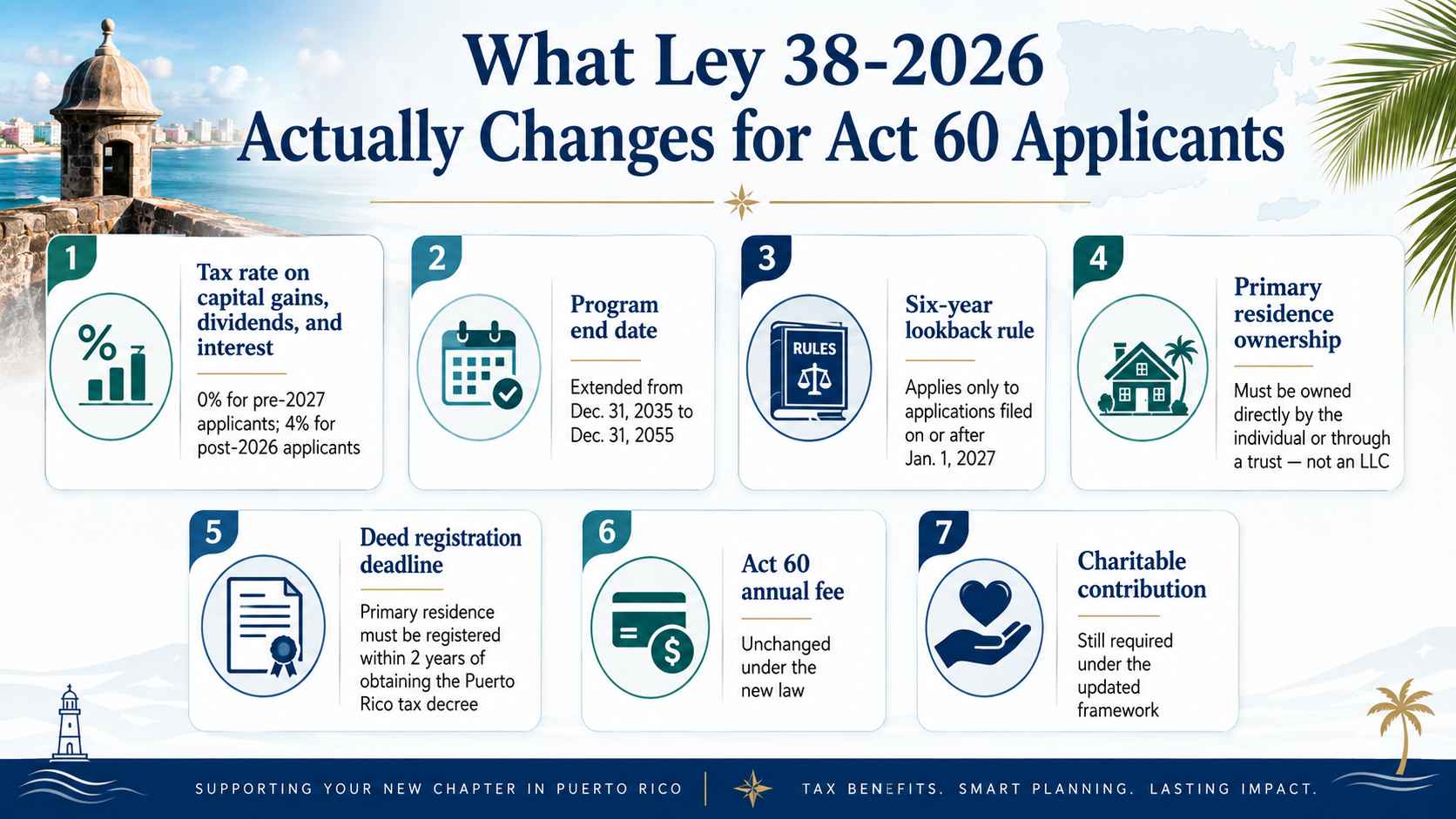
The Core Changes at a Glance
Tax rate on capital gains, dividends, and interest: 0 percent for pre-2027 applicants, 4 percent for post-2026 applicants.
Program end date: Extended from December 31, 2035 to December 31, 2055.
Six-year lookback rule: Applies only to applications filed on or after January 1, 2027.
Primary residence ownership: Must be owned directly by the individual or through a trust, not an LLC.
Deed registration deadline: Primary residence must be registered within two years of obtaining the Puerto Rico tax decree.
Act 60 annual fee: Unchanged under the new law.
Puerto Rico Act 60 charitable contribution: Still required under the updated framework.
Why the Six-Year Lookback Matters
The six-year nonresidency rule is perhaps the most overlooked piece of Ley 38-2026. If you lived in Puerto Rico at any point during the six years before your application date, you may not qualify under the post-2026 rules. This requirement targets applicants who previously established Puerto Rico tax residency, left the program, and then attempted to re-enter.
For first-time applicants with no prior ties to Puerto Rico, this rule likely poses no problem. But for anyone who explored the island, rented a property here, or tested the waters before committing, the lookback period deserves careful review with a qualified tax advisor.
With the core changes laid out, the next step is understanding what those changes cost in real numbers, depending on when you apply.
Before vs. After the Deadline: A Real Cost Comparison
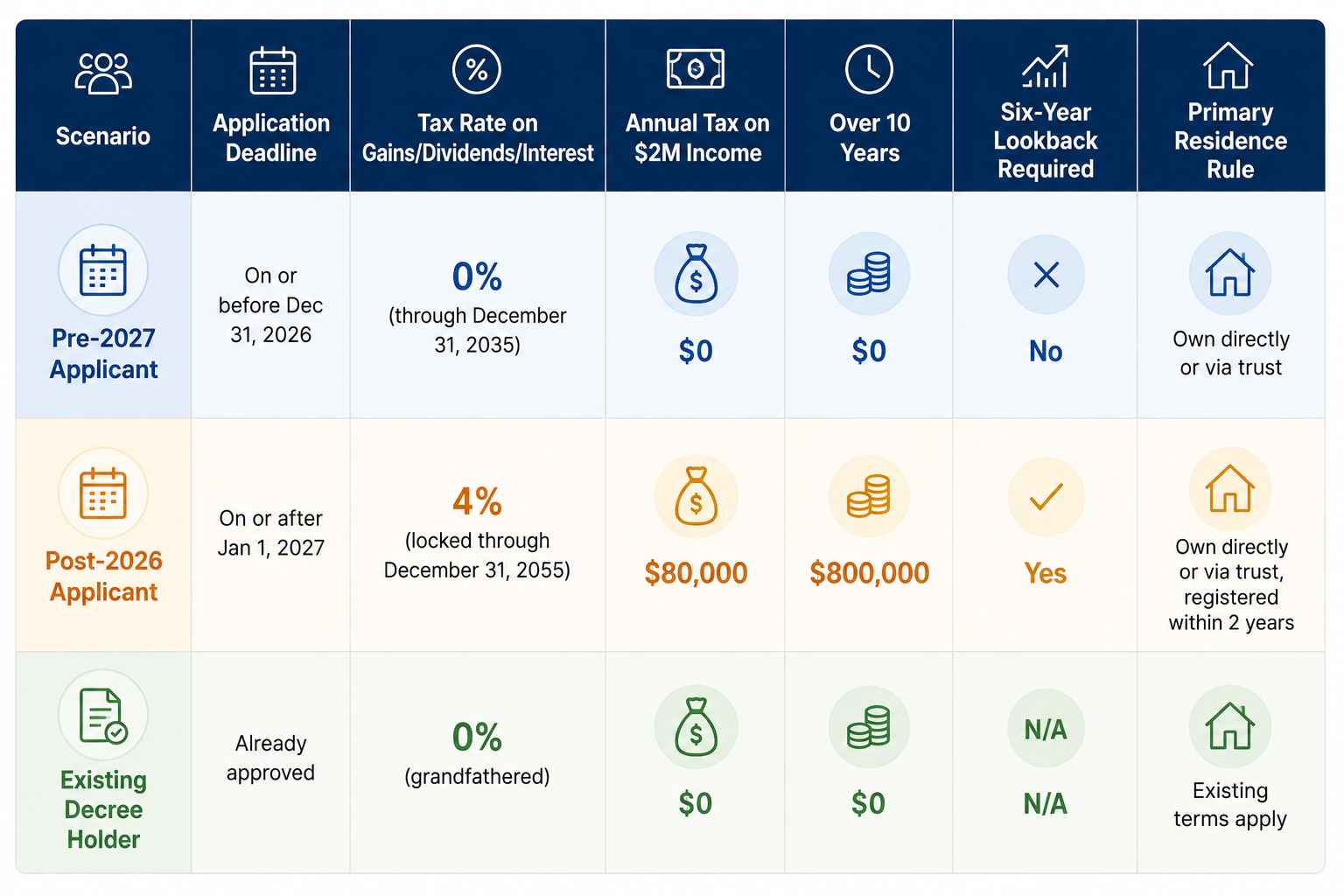
The difference between a December 31, 2026 application and a January 1, 2027 application is not symbolic. It is a measurable, permanent difference in your effective tax rate on investment income for the life of your Puerto Rico tax decree. To put that in perspective, consider an investor with $2 million in annual capital gains, dividends, and interest income.
The numbers above assume steady income. For investors with larger portfolios or liquidity events planned, the gap widens considerably. A $10 million capital gain triggers a $400,000 tax bill under the post-2026 structure, compared to zero under the current one.
Note: For post-2026 applicants, certain pre-residency long-term capital gains are taxed at 5 percent rather than 4 percent under Sections 2022.01(b) and 2022.02(d) of the Puerto Rico Incentives Code.
If You Apply Before the Deadline
Filing your Act 60 application before December 31, 2026 locks in the 0 percent tax rate structure through December 31, 2035, the original program sunset date. Post-2026 applicants trade the 0 percent rate for a 4 percent rate but gain a longer benefit window that runs through 2055. You avoid the six-year lookback requirement entirely.
You still need to meet the existing Act 60 requirements, including establishing genuine Puerto Rico tax residency, meeting the 183-day presence test, and satisfying the Puerto Rico primary residence requirement.
File your Act 60 application before December 31, 2026.
Establish Puerto Rico tax residency and meet the 183-day presence rule.
Acquire your primary residence directly or through a trust, not an LLC.
Register the deed within two years of receiving your Puerto Rico tax decree.
Pay the Act 60 annual fee and fulfill the Puerto Rico Act 60 charitable contribution requirement, which was raised under the updated framework .
Maintain records that demonstrate your closer connection to Puerto Rico than to any U.S. state.
If You Wait Until After 2026
Waiting past the deadline does not disqualify you from the program. The Puerto Rico tax incentive program now runs through 2055, so there is still time. What changes are in the cost structure and the eligibility requirements?
You pay a 4 percent fixed rate on post-residency capital gains, dividends, and interest, rather than zero, with a 5 percent rate applied to certain pre-residency long-term capital gains.
You must prove six years of non-Puerto Rico residency before applying.
The primary residence must now be held directly, jointly with a spouse, or through a qualifying grantor trust, with the deed registered in the Puerto Rico Property Registry within 2 years — LLC ownership is no longer accepted for new applicants.
The Act 60 annual fee and charitable contribution obligations still apply.
Your decree runs through 2055, giving you a longer benefit window than pre-2026 applicants had under the old 2035 end date.
For some investors, 4 percent is still a compelling rate compared to U.S. federal capital gains tax rates, which can reach 23.8 percent with the net investment income surtax. The question is whether the lifestyle and logistical commitment of Puerto Rico tax residency makes sense at that rate for your specific income profile.
If You Already Hold a Decree
Existing Act 60 investor decree holders have nothing to worry about under Ley 38-2026. The law explicitly preserves the terms of existing decrees. Your Act 60 4 percent tax rate, or more precisely your 0 percent rate if you hold a pre-2027 decree, stays intact. No action is required to protect your current status.
That said, any material change to your decree, such as a modification request or a lapse in compliance, could potentially trigger a review. Staying current on your annual filings and residency requirements remains the safest path.
Existing decree holders may also voluntarily elect to swap their grandfathered 0 percent rate (which expires in 2035) for the new 4 percent rate locked in through 2055 — a trade-off worth discussing with a tax advisor if you plan to hold your decree past 2035.
The Residency and Property Requirements You Cannot Ignore
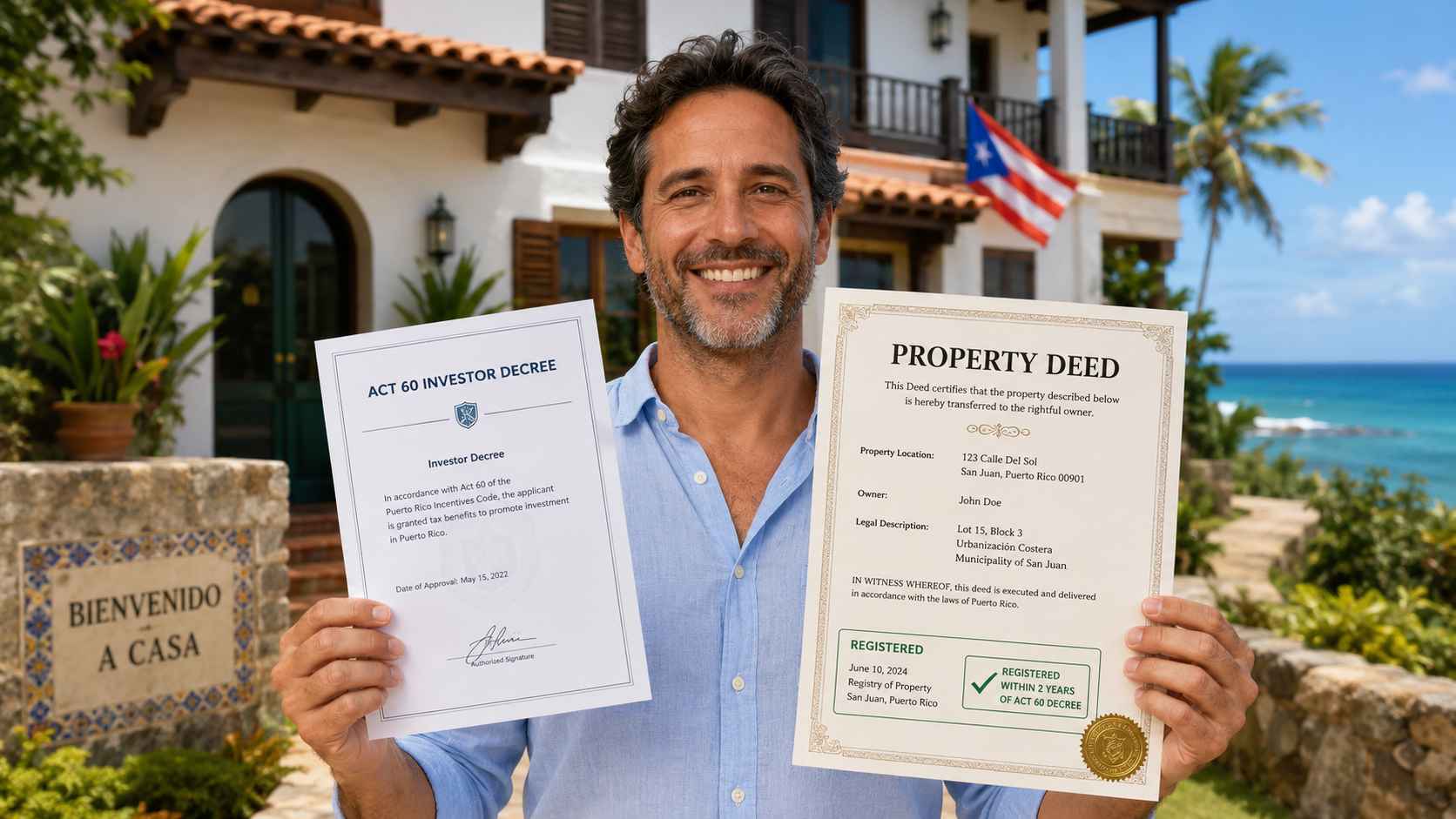
Puerto Rico tax residency under Act 60 has always required more than just being present on the island for 183 days. You need to demonstrate that Puerto Rico is your genuine home, not a tax address. Ley 38-2026 tightens this further with the primary residence ownership rule and the six-year lookback for post-2026 applicants.
The primary residence rule now requires that the home be owned directly by the individual or a trust, not through an LLC or another entity.
Primary Residence Ownership Rules
The home must be owned directly in your name or through a qualifying trust.
LLC ownership does not satisfy the primary residence requirement under the updated law.
The deed must be registered within two years of receiving your Act 60 investor decree.
Renting a home during the initial period may be permissible, but you must complete the purchase within the two-year window.
The property must serve as your actual primary residence, not a vacation home or investment property.
What Puerto Rico Tax Residency Actually Demands
Meeting the 183-day rule is the floor, not the ceiling. The IRS looks at a broader set of factors to determine whether you have genuinely broken your connection to your prior U.S. state of residence. You need to show that your closer connection is to Puerto Rico.
Spend more than 183 days per year physically present in Puerto Rico.
Register your vehicle and obtain a Puerto Rico driver's license. Move your bank accounts, professional licenses, and memberships to Puerto Rico.
Register to vote in Puerto Rico if eligible.
Ensure your primary residence is in Puerto Rico, not in a U.S. state.
File Puerto Rico tax returns and pay the Act 60 annual fee on time.
Some Reddit users discussing Act 38 Puerto Rico have flagged confusion about whether partial-year residency during a transition period satisfies the rules. The answer depends on the specific facts of your situation, and a tax attorney familiar with the Puerto Rico investor decree structure should review your timeline before you commit.
Once you understand the residency demands, the next question is whether the Puerto Rico real estate market offers the right properties to meet those requirements at a level that matches your lifestyle.
Puerto Rico Luxury Properties for Sale
For Act 60 applicants who need to acquire a primary residence in Puerto Rico, the property decision carries both financial and legal weight. Christie's International Real Estate Puerto Rico specializes in luxury properties for sale across the island's most sought-after markets, from beachfront estates in Rincon to historic residences in Old San Juan.
Whether you are searching for a primary residence to satisfy your Act 60 requirements or a long-term investment in Puerto Rico luxury real estate, the following listings represent some of the finest opportunities currently available.
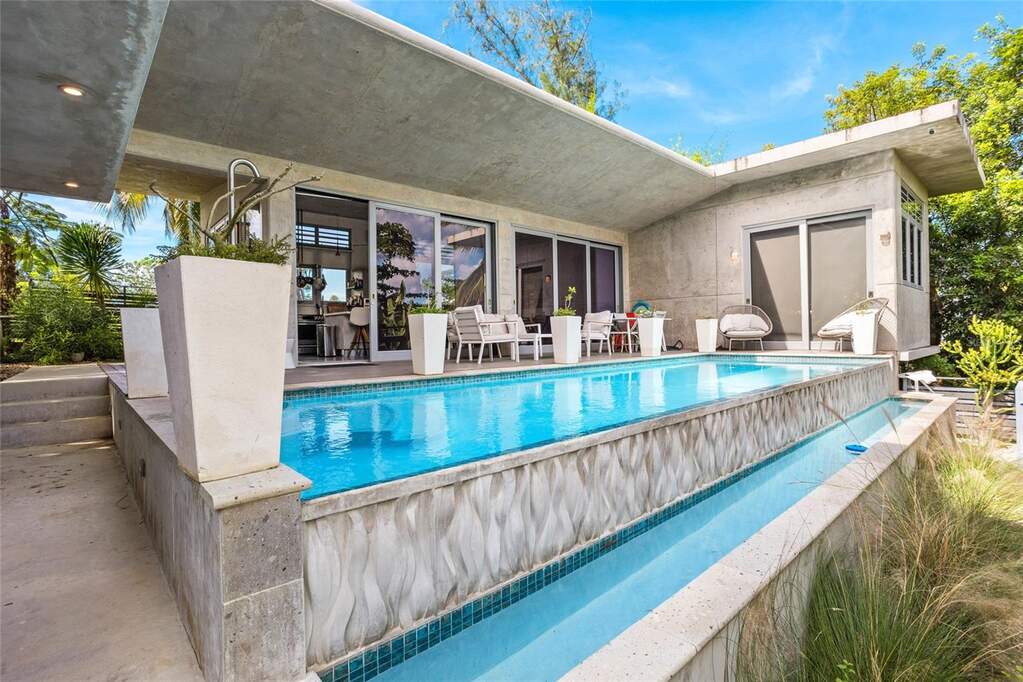
PR 413 Solar C Bo. Puntas, Rincón, PR 00677, Puerto Rico
This exceptional beachfront parcel in Rincon's coveted Bo. Puntas neighborhood offers direct access to some of Puerto Rico's most celebrated surf and sunset coastline. It represents a rare opportunity to build a custom primary residence in one of the island's most desirable luxury real estate corridors.
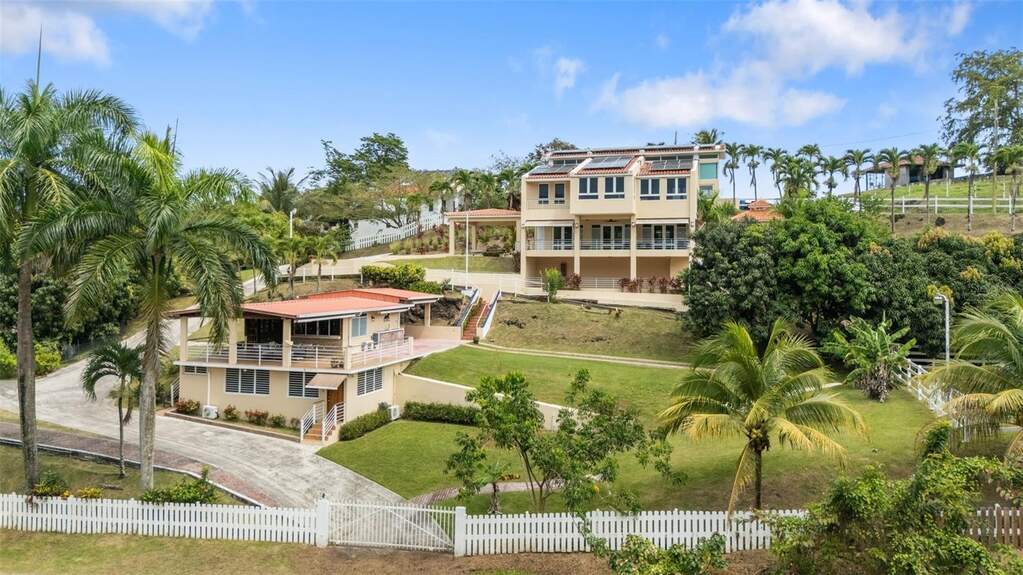
23 and 24 Hacienda Carabali, Luquillo, PR 00773, Puerto Rico
Set within the lush foothills near Luquillo, these two adjoining parcels at Hacienda Carabali offer privacy, mountain views, and proximity to El Yunque National Forest. The combined landholding appeals to buyers seeking a private estate compound in Puerto Rico's luxury real estate market.
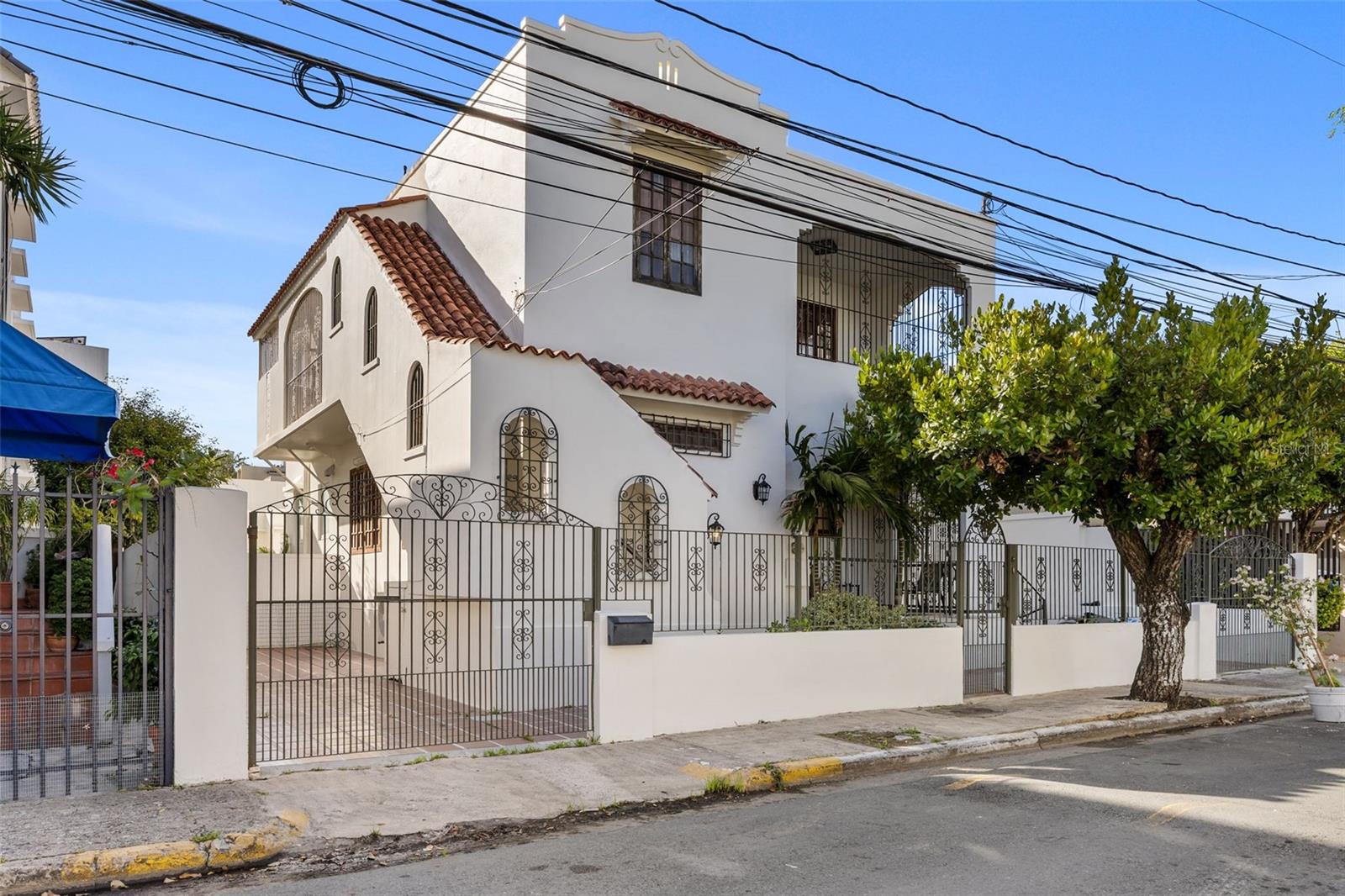
652 Calle Hernández, Miramar, PR 00907
Located in Miramar, one of San Juan's most established and walkable neighborhoods, this property delivers urban convenience alongside the character of Puerto Rico luxury homes. It suits Act 60 applicants who want a primary residence within close reach of San Juan's financial district and marina.

Calle Sol Ph Unit 301, San Juan, PR 00901, Puerto Rico
This penthouse unit on Calle Sol places you at the heart of Old San Juan, offering a refined urban lifestyle inside one of the island's most historic and architecturally significant streets. For Act 60 applicants seeking a primary residence that also serves as a second property, this listing stands out in Puerto Rico's luxury real estate market.
Final Thoughts on the New Cost of Act 60
Act 38-2026 did not close the door on Puerto Rico's Act 60 program, but it did raise the price of admission for anyone who waits past December 31, 2026. The choice comes down to whether you file under the current 0 percent structure or accept the new 4 percent rate in exchange for a longer benefit window through 2055. Either way, the residency and property rules now demand a genuine commitment to island life, not a paper address.
If you are looking to buy, sell, or rent luxury properties in Puerto Rico, Christie's International Real Estate Puerto Rico is the trusted partner to guide you through every step. Their team pairs deep local market knowledge with the discretion and expertise high-net-worth clients expect. Contact Christie's International Real Estate Puerto Rico today to explore your next move across the island's most sought-after addresses.
FAQs
Does the 4% post-2026 rate apply to Puerto Rico–source income only, or worldwide investment income?
It generally applies to income that qualifies under the decree rules and Puerto Rico sourcing; U.S.-source income and pre-move gains can still be taxed federally. Confirm sourcing and “after you become a bona fide resident” timing with a Puerto Rico tax advisor before relying on the 4% rate.
What happens if I get a decree but later fail the residency or compliance requirements?
Noncompliance can result in the loss of benefits, tax reassessments, penalties, and interest, and may jeopardize future renewals or amendments. Treat annual filings, presence, and “closer connection” documentation as ongoing obligations, not one-time steps.
Can I change my primary residence after purchasing, and still satisfy the rule?
Usually yes, but you must maintain a qualifying primary residence in Puerto Rico and keep the ownership structure compliant (individual or trust) with proper deed registration. If you plan to buy, sell, or move within the first two years, coordinate the timing and paperwork to avoid a technical violation.