
Act 60's real estate requirement changed in a concrete way on March 10, 2026: Ley 38-2026 keeps the incentive alive through 2055 but swaps the 0% tax rate for a 4% rate on qualifying dividends, interest, and capital gains for anyone filing a Resident Individual Investor application on or after January 1, 2027, while tightening enforcement of the two-year window to buy a primary residence.
Christie's International Real Estate Puerto Rico has represented Act 60 buyers through the evolution of Puerto Rico's individual investor incentives, most recently under the Act 38-2026 amendments. This breaks down what changed, what the purchase requirement means for your timeline, and which neighborhoods carry the heaviest grantee demand.
Disclaimer: This article provides general information only and is not tax, legal, or immigration advice. Act 60 requirements, including the Ley 38-2026 modifications, are complex and change. Consult a licensed Puerto Rico tax attorney before making Act 60 decisions.
Key Takeaways
Applications filed by December 31, 2026 may preserve the 0% rate on qualifying income.
Applications filed from January 1, 2027 face a 4% rate and a six-year prior non-residency rule.
Decree holders must purchase and register a qualifying primary residence within two years.
Bona fide residency requires presence, closer connection, and tax-home compliance.
A luxury home search should account for power, insurance, construction, connectivity, and security.
What Changed in Act 60 With Ley 38-2026: 0% Becomes 4% for New Filers

The sunset on the entire Resident Individual Investor program moved out to December 31, 2055, so the incentive itself isn't disappearing. Post-2026 applicants also face a new six-year prior non-residency requirement: anyone filing on or after January 1, 2027 must show they were not a bona fide Puerto Rico resident during the six taxable years immediately preceding the application. That test didn't exist under the old rules and is one of the reasons the December 31, 2026 filing cutoff matters as much for someone who previously spent time on the island as it does for the rate change.
Puerto Rico tax attorneys have reported clients accelerating decree filings to beat the December 31, 2026 cutoff, a pattern consistent with what Christie's PR is seeing on the property side. The property-side response has tracked the tax-side rush: Christie's PR has seen elevated showing activity from Act 60 candidates in the second half of 2026, concentrated in Dorado, as buyers work to align a home purchase with a pre-2027 decree filing.
The Act 60 Property Purchase Requirement and Timeline
Resident Individual Investor decree holders must buy a principal residence in Puerto Rico within two years of the decree's grant date, and Ley 38-2026 (Act 38-2026) went further than just tightening enforcement. The residence must now be owned directly by the individual or through a qualifying trust — not through an LLC or other holding entity — and must be registered in the Puerto Rico Property Registry within the two-year window. Buyers who planned to title through a mainland LLC for asset-protection reasons need to restructure that plan before closing.
What that means in practice for buyers under the new rules:
The 2-year clock starts on the decree grant date, not the residency establishment date.
Ownership must be direct — individual name or qualifying trust — not through a mainland or PR LLC.
The deed must be registered with the Puerto Rico Property Registry within the same 2-year window.
The property must serve as an actual primary residence; a pure short-term rental won't qualify.
The law also left the 4% corporate tax rate and 100% exemption on Puerto Rico-sourced dividends for Act 60 export services companies unchanged, so business owners running an export services entity face a different set of rules than individual investors buying real estate.
A qualifying Act 60 home must be purchased and maintained as the decree holder’s principal residence; renting first does not satisfy the purchase requirement. Because rental use can complicate whether a property remains a true principal residence, buyers considering short-term rental activity should obtain advice from a licensed Puerto Rico tax attorney before relying on the property for Act 60 compliance.
Bona Fide Residency Runs on Three Tests, Not One
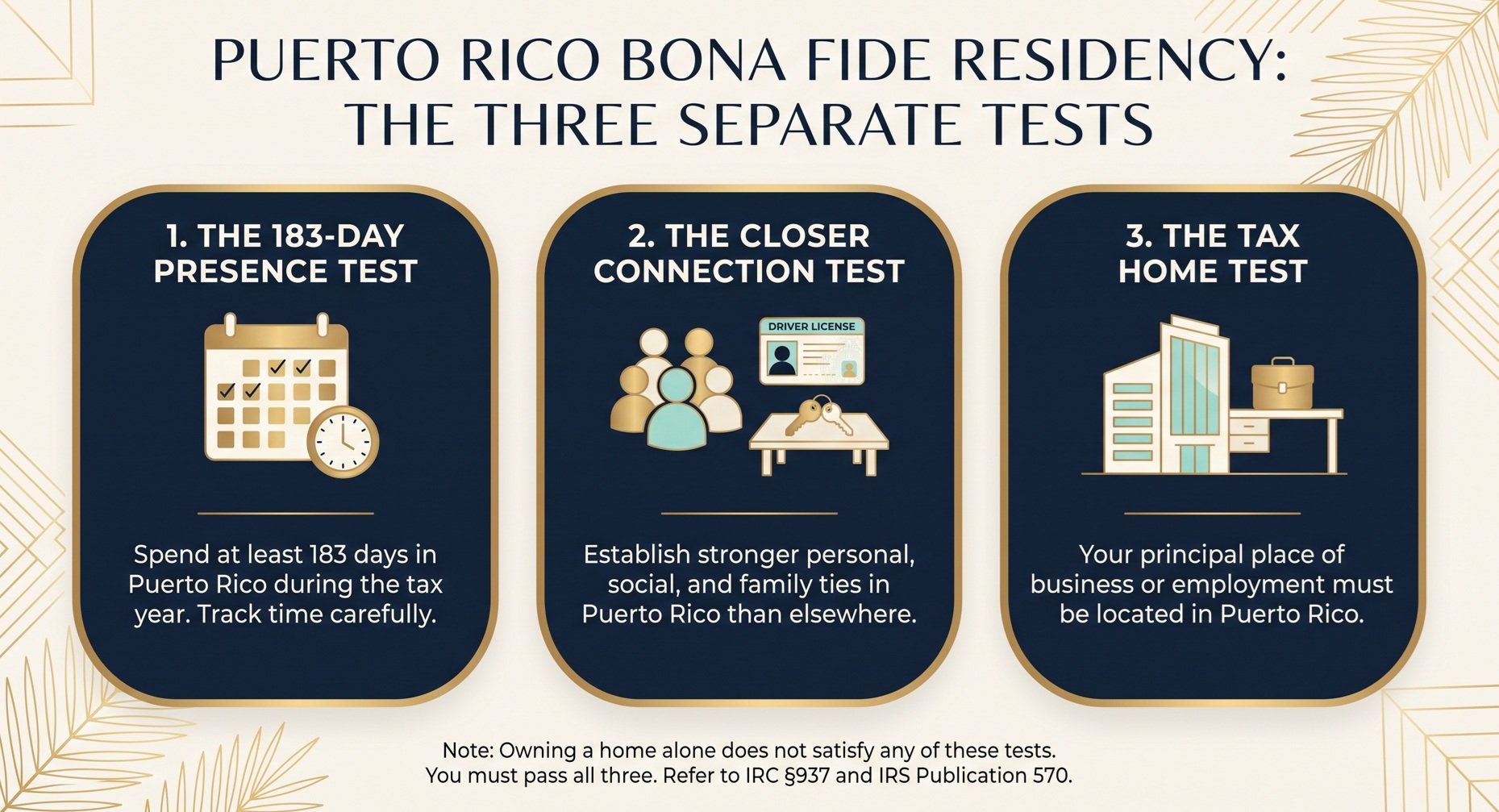
Passing Puerto Rico's bona fide residency standard means clearing three separate IRS tests under IRC §937 and IRS Publication 570, and owning a home alone satisfies none of them.
The 183-Day Presence Test
You need to spend at least 183 days in Puerto Rico during the tax year, tracked in a way that survives an audit.
A December 2025 GAO report (GAO-26-107225) on IRS oversight of Puerto Rico tax exemption claimants confirms that both the IRS and Puerto Rico's Hacienda are actively scrutinizing actual time on-island; the IRS has opened roughly 100 investigations of Act 20/22/60 participants since 2023, and Hacienda has separately audited about 1,800 decree holders. Treating the program as a paper move carries real audit risk.
The Closer Connection Test
This measures where your family, driver's license, doctors, and social ties actually sit. Sánchez-Rivera notes that Hacienda increasingly cross-references utility accounts and school enrollment against the days claimed on a taxpayer's calendar.
The Tax Home Test
Your principal place of business or employment needs to be in Puerto Rico, which matters for remote executives who assume a mailing address is enough. A December 2025 r/ExpatFIRE thread points out that gains earned before establishing Puerto Rico residency don't get wiped out by Act 60, so timing your move against a liquidity event matters more than most applicants expect.
The $10,000 Charitable Contribution Requirement Hasn't Moved
Individual Resident Investor decree holders still owe a $10,000 annual charitable contribution to Puerto Rico nonprofits, and Ley 38-2026 left this obligation unchanged even as it raised the tax rate for new filers. Sánchez-Rivera flags this as one of the few Act 60 mechanics that stayed static in 2026 while almost everything else around it moved, and recommends clients set up the donation before the decree's compliance deadline rather than scrambling in December.
What Happens If You Miss the Residency or Purchase Deadline
Missing bona fide residency or the two-year purchase window risks decree revocation and retroactive taxation at standard Puerto Rico rates on income you assumed was exempt. An October 2025 r/fatFIRE thread describes high earners who explored Act 60, then abandoned the plan once they realized how disruptive a genuine relocation actually is, from moving family to restructuring where business gets conducted.
A meaningful share of buyers who begin the Act 60 process step back once the full compliance overhead — the 183-day test, the charitable contribution, the ongoing annual reporting — becomes concrete rather than theoretical.
Act 60 vs Act 22 vs Act 20 vs the Alternatives
Act 60 consolidated the former Act 22 (Individual Investors) and Act 20 (Export Services) into one incentives code in 2019, and prospective relocators frequently weigh it against Dubai, Portugal, Malta, or simply moving to a no-income-tax state like Florida or Texas.

Best Neighborhoods for Act 60 Relocators
Act 60 relocation demand concentrates in five Puerto Rico submarkets, each drawing a different buyer profile.
Dorado – gated beachfront communities, strong privacy, and the tightest inventory of homes above $1 million; average luxury home value in Dorado Beach now exceeds $2.8 million, with Q1 2026 appreciation in the luxury segment reported at 6–14% year over year depending on submarket.
Bahia Beach – newer construction, resort-adjacent amenities, and a growing base of families relocating for the first time.
Condado – walkable, hotel-adjacent lifestyle favored by fund managers and executives who still travel to the mainland frequently.
Palmas del Mar – golf and equestrian lifestyle with gated privacy, popular with business owners selling mainland companies.
Guaynabo – lower price point, established expat community, proximity to hospitals and the airport.
A March 2023 BiggerPockets discussion on Act 60 investing notes that this concentrated demand has pushed prices up specifically in Condado and Dorado, and Christie's PR's own pipeline over the past two years backs that pattern almost exactly.
What Act 60 Buyers Prioritize Beyond Location
Location drives the first conversation, but Act 60 grantees consistently ask about the same four property features when evaluating Puerto Rico luxury properties.

Backup power capacity, since PREPA grid outages — often multi-day after a named storm and periodic even without one — shape day-to-day livability more than mainland buyers expect. Solar-plus-battery is now standard on newer Dorado and Bahia Beach product for exactly this reason.
Hurricane-resilient construction and updated roofing, since post-María insurance underwriters price wind exposure aggressively; concrete construction and impact-rated openings materially affect both insurability and monthly carry.
Fiber internet infrastructure, which is uneven island-wide but well-established inside gated Dorado, Bahia Beach, and Palmas del Mar communities.
Private security or gated access, particularly for founders and public-facing executives whose Act 60 relocation was itself covered in the tech or finance press.
Hurricane exposure, property insurance availability, and lender requirements can materially affect a Puerto Rico purchase timeline and carrying costs. Buyers should request insurance indications and financing guidance early in due diligence, particularly for coastal or resort-area homes.
Five Anonymized Act 60 Relocations
Act 60 buyer archetypes fall into a few recognizable patterns rather than a single profile.
Founders anticipating a liquidity event tend to move fastest, filing decrees ahead of a sale and gravitating toward gated Dorado product.
Fund managers who still need mainland office access tend to favor Condado for its walkability and airport proximity.
Business owners preparing an eight- or nine-figure sale often relocate a year or more before filing, so the gain sources after residency is genuine.
Retiree couples usually prioritize simplicity and community over aggressive tax structuring, which points them toward Guaynabo.
And a subset of remote executives rent first — often in Old San Juan — to test the lifestyle before committing to a decree and a purchase, which the two-year post-decree window still accommodates.
Where Puerto Rico Wins Over Dubai, Portugal, or Florida — and Where It Doesn't
Puerto Rico's real advantage over Dubai, Portugal, or Malta is proximity: direct flights of three to four hours from New York or Miami, US legal system and title insurance, USD, and no passport or visa process. Act 60's capital gains exemption applies specifically to appreciation earned after residency is established, which sophisticated buyers moving from equity or crypto positions need to understand before assuming a windfall is fully protected.
Where it wins: no foreign ownership restrictions, familiar contract law, US banking access, and a real capital gains benefit on post-residency appreciation.
Where it doesn't: Puerto Rico isn't zero-tax on worldwide income the way Dubai can feel for some structures, the compliance overhead around the 183-day test and charitable contribution is real and ongoing, and hurricane exposure raises insurance costs in a way Portugal or Florida buyers rarely budget for.
Christie's PR walks every relocating client through this trade-off honestly during the first consultation, because the buyers who do best under Act 60 are the ones who treat the move as a genuine relocation, not a tax filing.
Puerto Rico Luxury Properties for Sale
For investors and buyers evaluating Act 60 opportunities, Puerto Rico’s luxury real estate market offers strong options for primary residence planning, lifestyle upgrades, and long-term asset positioning. Christie's International Real Estate Puerto Rico helps qualified buyers explore luxury properties for sale in highly desirable areas such as San Juan, Dorado, Carolina, and other premium island markets. The sample listings below show how luxury homes, penthouses, and resort-style residences can support both Act 60 planning and an elevated Puerto Rico lifestyle.
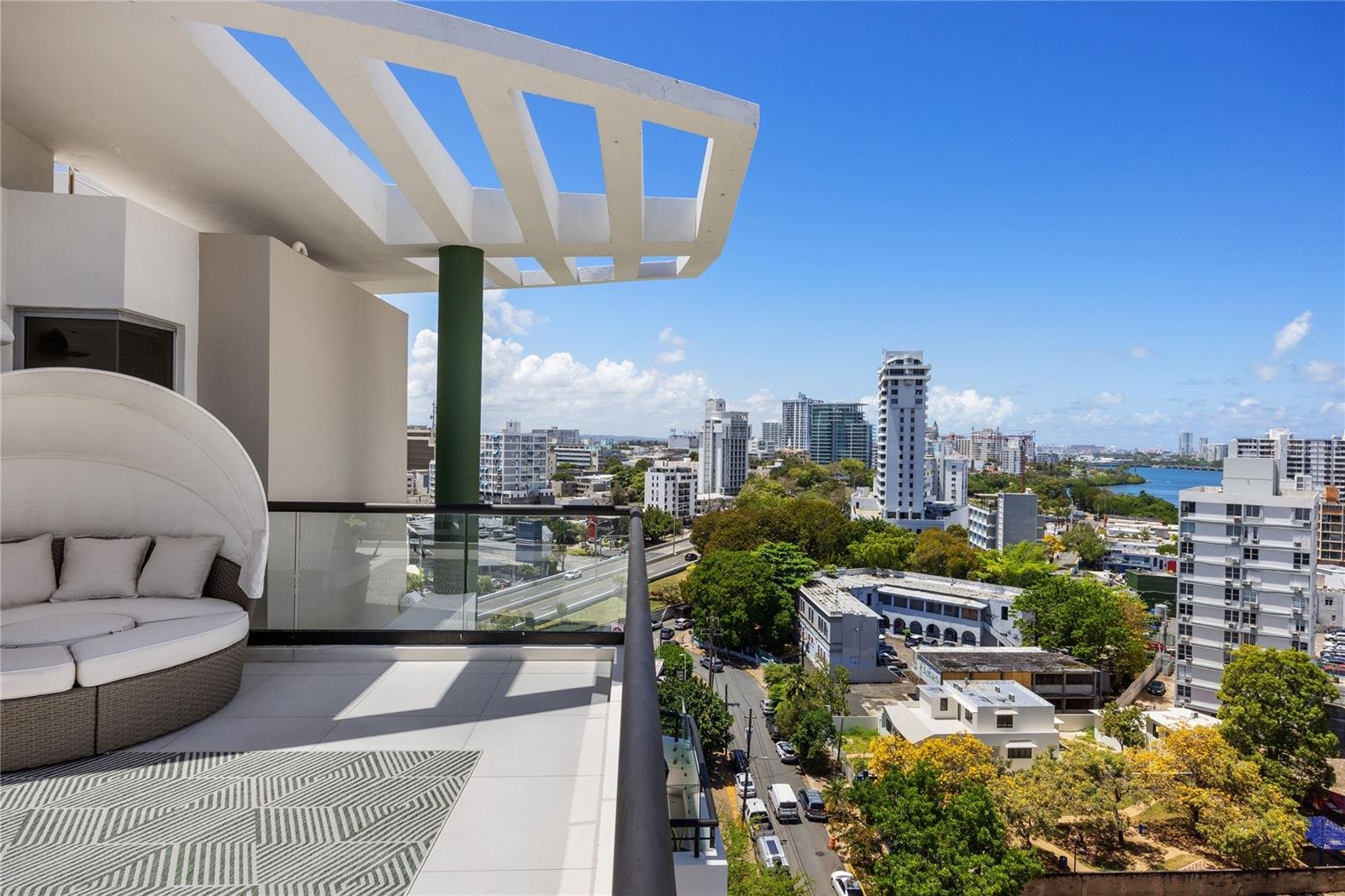 1212 Luchetti St #PH, San Juan, PR 00907
This San Juan penthouse is listed at $3,850,000 and features 2 bedrooms, 3 bathrooms, and 4,475 square feet of condominium living space. Its size and Condado-area address make it a strong fit for buyers seeking an urban luxury residence with generous interior space.
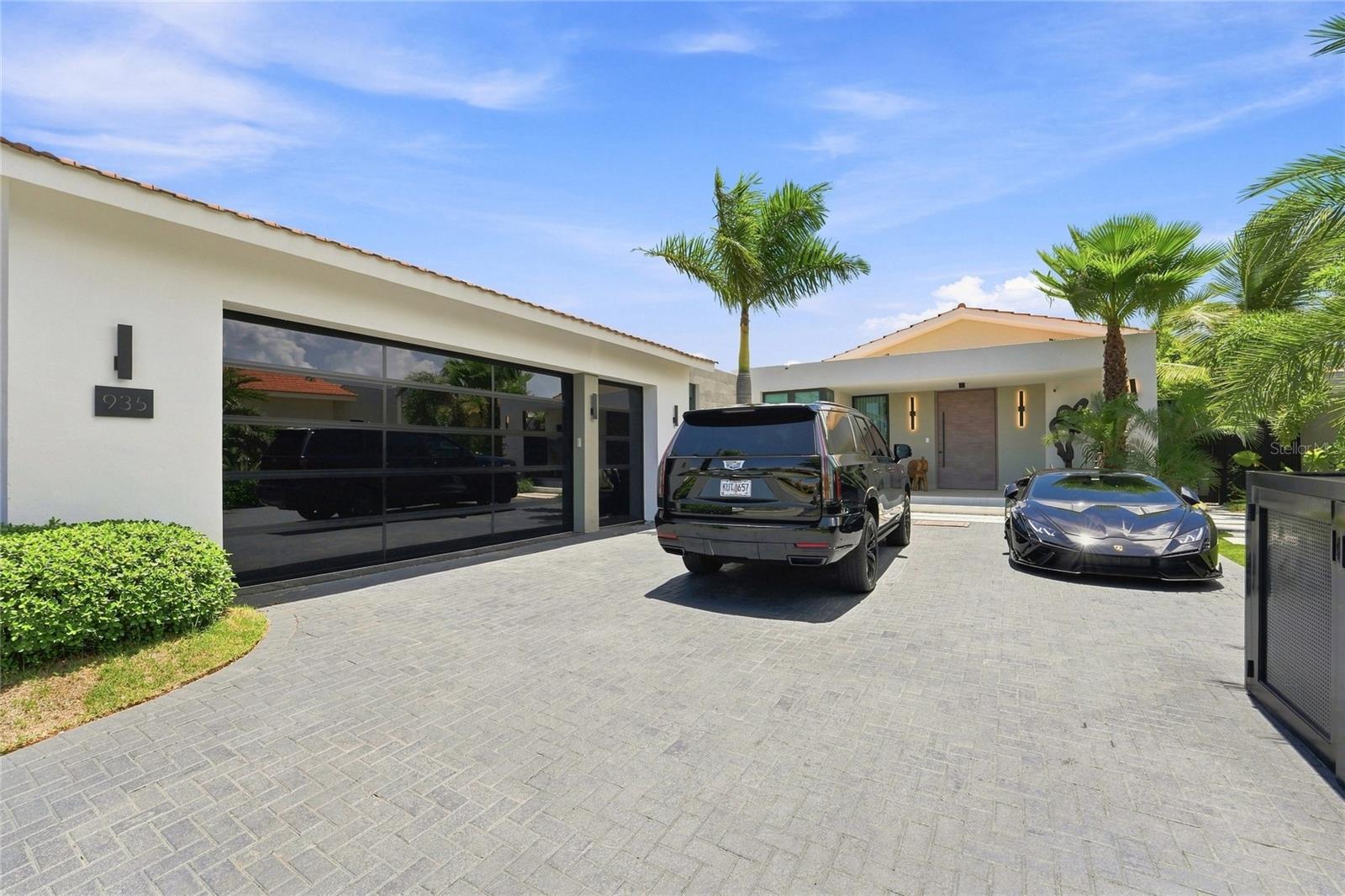
935 ISLA NORTE DORADO PR, 00646
Built in 2023, this fully furnished Isla Norte residence offers five en-suite bedrooms, approximately 5,100 sq. ft. of interior space, a private pool, lush landscaping, and peaceful, protected greenery views near TASIS Dorado.
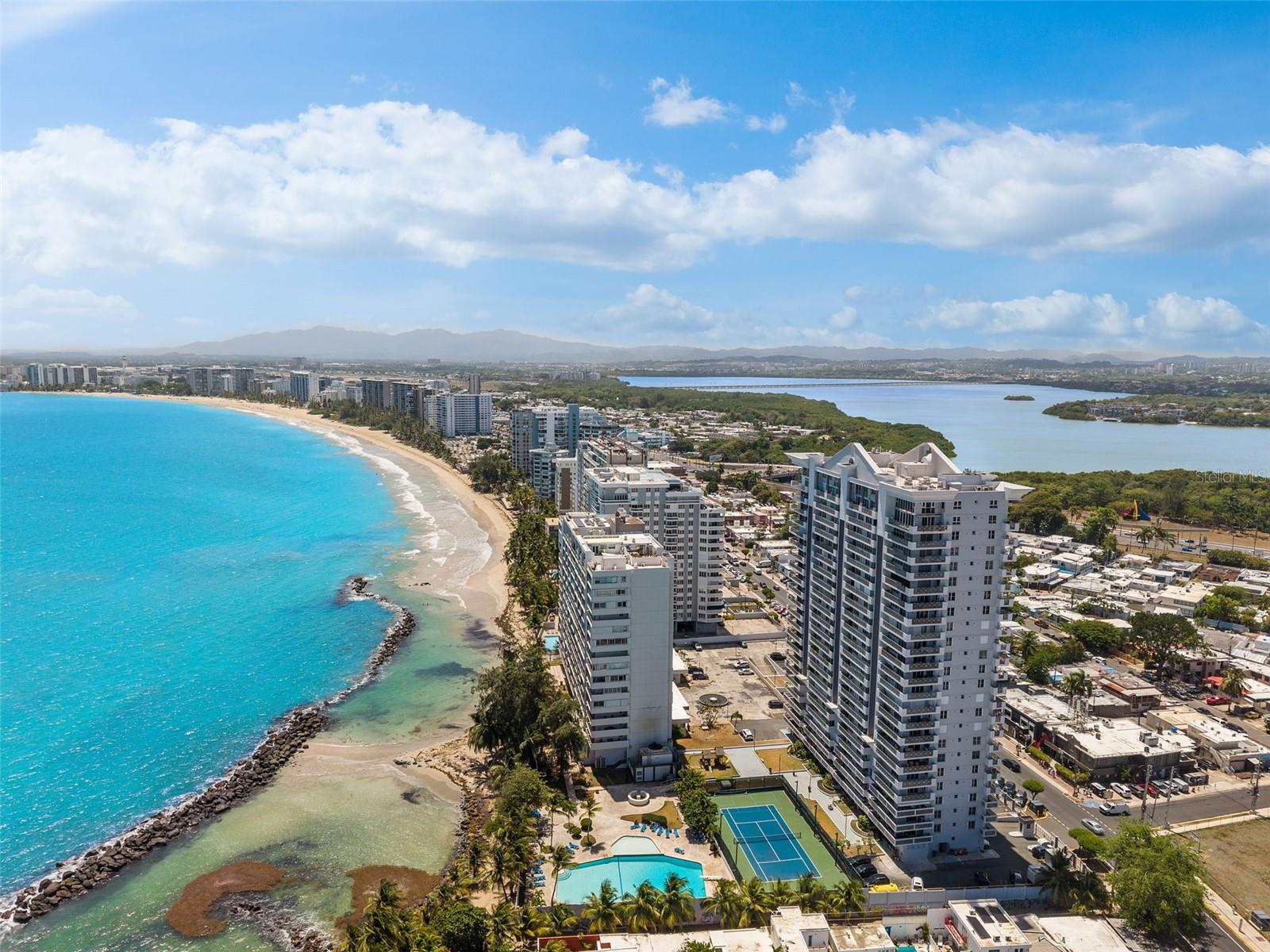
3001 AVENIDA ISLA VERDE #2204, CAROLINA PR, 00979
This fully remodeled 22nd-floor corner residence offers nearly 2,000 square feet, three bedrooms convertible to four, panoramic balconies, premium finishes, and direct access to a calm sandy beach.
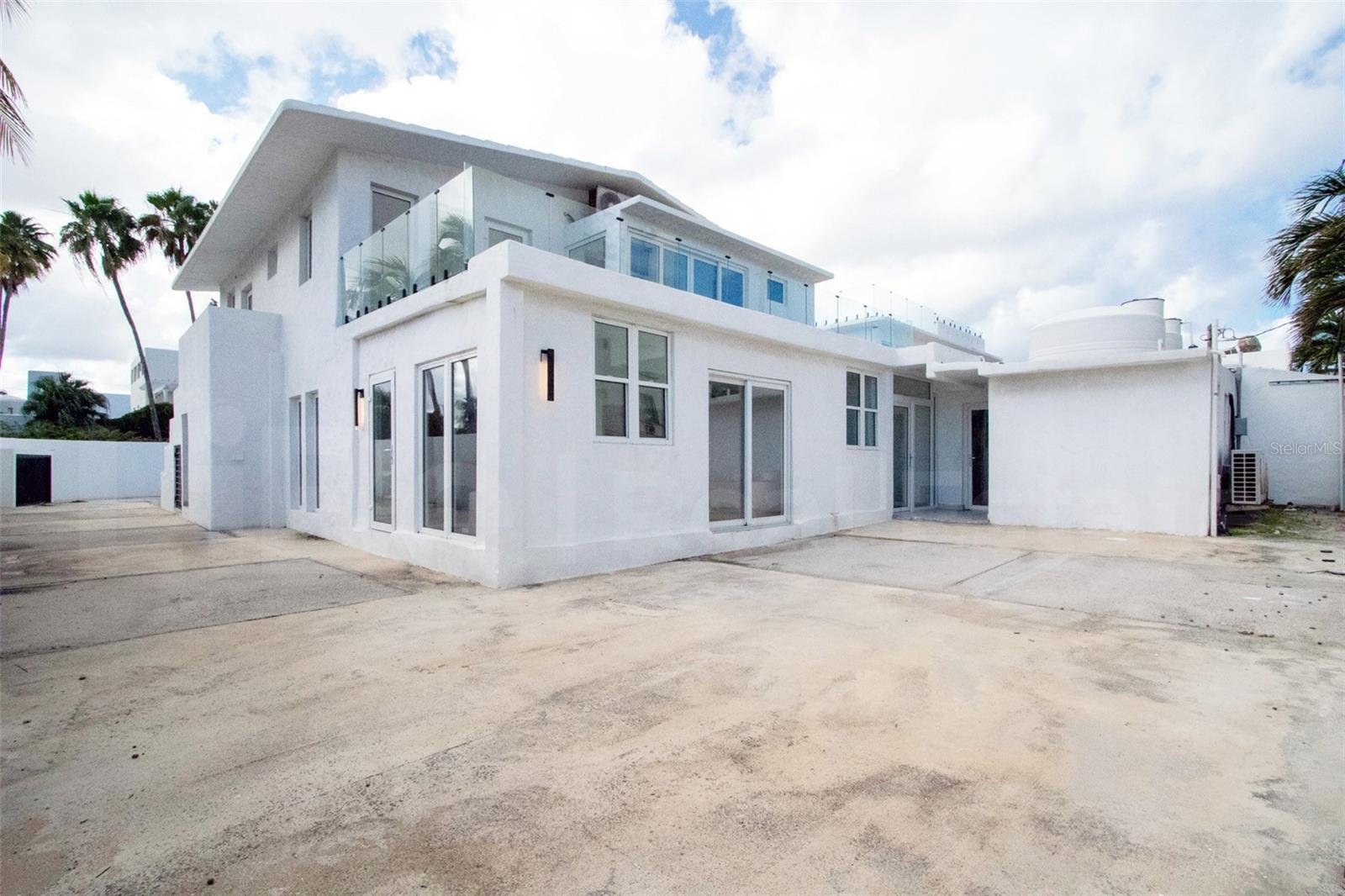 2073 Cacique St, San Juan, PR 00911
This San Juan residential property is listed at $2,600,000 and features 6 bedrooms, 8 bathrooms, 3,221 square feet, and 2 garage spaces. With a 2025 build year and a larger bedroom count, it may appeal to buyers seeking a newer luxury home with flexible space for family, guests, or extended stays.
Conclusion
Act 60 still works, but Ley 38-2026 rewards buyers who move fast and document their residency correctly. Talk to a licensed Puerto Rico tax attorney before filing a decree, then talk to a specialist who understands how that decree shapes your property search. Contact a Christie's International Real Estate Puerto Rico specialist to review current listings in Dorado, Condado, and Bahia Beach that fit Act 60 buyer timelines.
Disclaimer: This article provides general information only and is not tax, legal, or immigration advice. Act 60 requirements, including the Ley 38-2026 modifications, are complex and change. Consult a licensed Puerto Rico tax attorney before making Act 60 decisions.
Whether buying, selling, or renting, work with Christie's International Real Estate Puerto Rico for tailored guidance on luxury properties in Puerto Rico. Explore homes in Dorado, Condado, Bahia Beach, Palmas del Mar, and other sought-after communities. Connect with a local specialist to discuss your next move.
FAQs
Does renting first satisfy Act 60's primary-residence purchase requirement?
No. Renting can help you test neighborhoods and document real presence, but it does not replace the requirement to purchase and occupy a principal residence within the required timeframe after your decree is granted.
What documentation should I keep to support bona fide residency in an audit?
Maintain a "proof-of-life" file: travel records, Puerto Rico lease/deed, utility bills, local bank activity, medical and school records (if applicable), driver's license/vehicle registration, and a day-by-day calendar that matches objective evidence.
How should Act 60 buyers think about financing and insurance when shopping for a home?
Plan early: lender requirements, property condition, and hurricane/wind insurance availability can affect closing timelines and costs. Get pre-approval and insurance quotes during due diligence so underwriting or insurability surprises don't threaten compliance deadlines.