
Act 60 tax incentives for business owners have shifted dramatically, with new applicants now facing a 4% corporate tax rate instead of the previous 0% regime, though existing decrees remain grandfathered under the original terms. This change fundamentally alters the financial calculus for Texas entrepreneurs considering Puerto Rico as their new base of operations.
In this article, you'll discover how the updated Act 60 framework affects your tax strategy and luxury real estate decisions when relocating a business from Texas to Puerto Rico.
Key Takeaways
Act 60 still offers strong tax advantages for qualified Texas business owners.
New applicants should plan around the current 4% corporate tax structure.
Existing 0% decrees may remain grandfathered under original terms.
Luxury real estate can support both lifestyle goals and residency planning.
Christie's International Real Estate Puerto Rico can guide buyers, sellers, and renters in premium markets.
Updated Tax Mathematics: Texas vs Puerto Rico Under Current Act 60

Puerto Rico’s Act 60 offers qualifying export service businesses a 4% corporate tax rate, while
Individual resident investors with existing decrees typically enjoy 0% tax on Puerto Rico‑sourced dividends, interest, and post‑residency capital gains;
However, recent legislative changes phase in a 4% tax on passive income for new investor applicants, effective on specified dates.
The Puerto Rico vs Texas tax comparison still heavily favors Puerto Rico despite the increased rate from 0%. A Texas consulting firm generating $2 million annually would pay approximately $420,000 in federal taxes alone. The same business operating under Act 60 would face roughly $80,000 in Puerto Rico corporate taxes—a savings of $340,000 annually even at the new 4% rate.
Grandfathered 0% Decrees vs New 4% Applicants
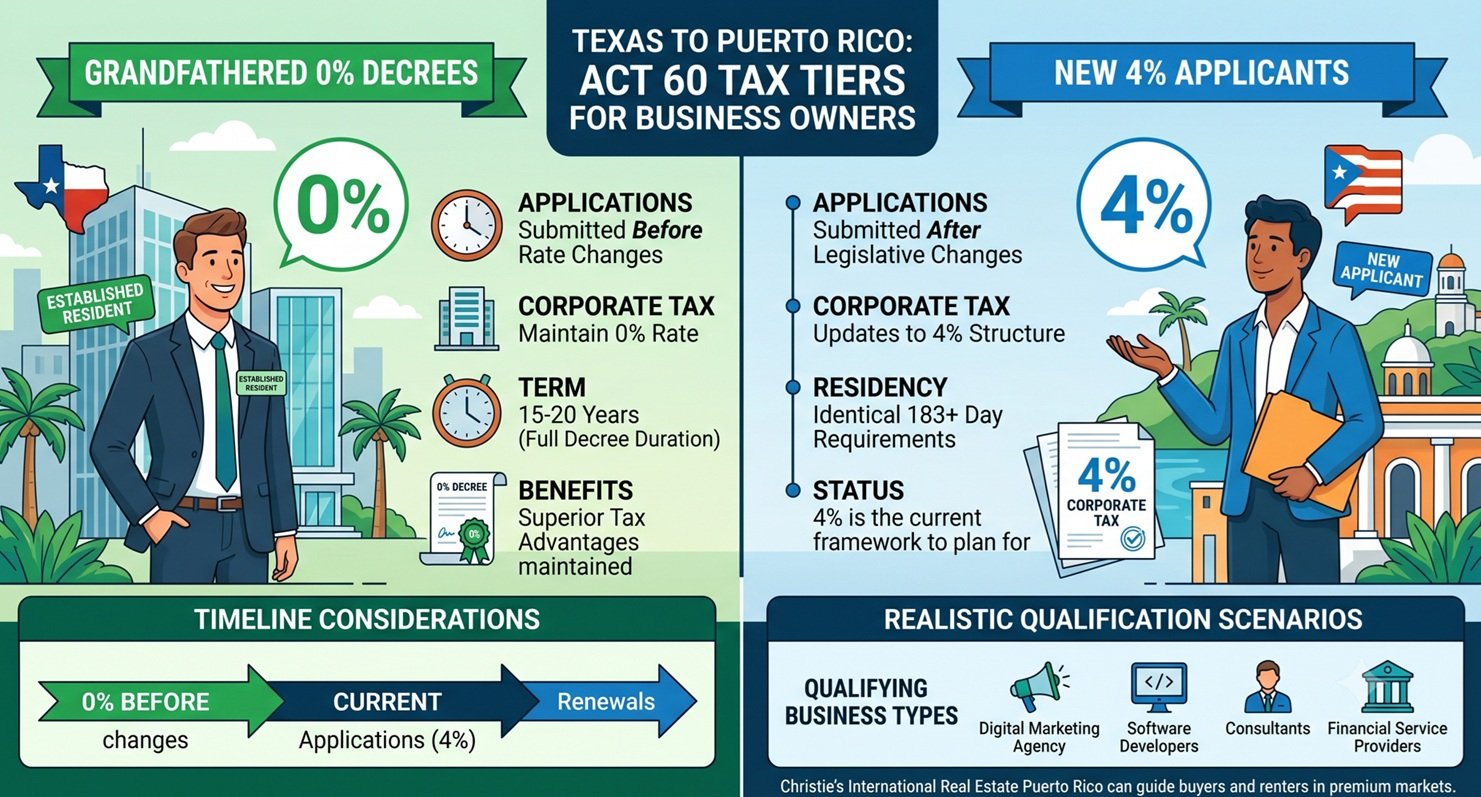
Existing Act 60 decree holders who secured their benefits before the rate changes continue operating under 0% corporate tax rates for their full decree term, typically 15-20 years. New applicants submitting after the legislative changes automatically receive the updated 4% structure with no option to access the original 0% benefits. Texas business owners evaluating Puerto Rico today must plan around the 4% framework rather than the widely publicized 0% regime.
The Act 60 0% grandfathered decrees create a two-tier system where established residents maintain superior tax advantages.
Timeline Considerations for Texas Relocators
Applications submitted before the rate changes: 0% corporate tax for the decree duration
Current applications: 4% corporate tax with full Act 60 benefits otherwise intact
Decree terms: 15-20 years with renewal options under original terms
Residency requirements: Identical 183+ day obligations regardless of tax rate tier
Realistic Qualification Scenarios
A Dallas-based digital marketing agency owner applying today qualifies for 4% corporate rates on export services while maintaining 0% on Puerto Rico-source investment income. Software developers, consultants, and financial service providers represent the most common Texas-to-Puerto Rico relocators under current rules.
Current Act 60 Requirements Affecting Texas Business Owners

Under current Act 60 rules, decree holders are typically required to purchase a primary residence in Puerto Rico within two years of decree approval, with minimum investment thresholds often starting in the low‑six‑figure range, and to maintain that property as their main home on the island.
Essential Compliance Elements
Maintain Puerto Rico driver's license and voter registration
Establish primary banking relationships with Puerto Rico institutions
Document 183+ days of annual presence with detailed logs
Invest required amounts in Puerto Rico real estate or businesses
File Puerto Rico tax returns as primary residence
Business Structure Adaptations
Export service companies: Often expected to maintain a minimum local payroll and staff headcount in Puerto Rico—commonly at least four full‑time employees for many decrees—along with meeting specified revenue and activity thresholds set out in the individual Act 60 grant.
Individual investor decrees: Focus on passive income and capital gains
Combined structures: Many Texas relocators utilize both business and investor components
Professional service firms: Legal, accounting, and consulting practices qualify readily
Luxury Real Estate Integration With 4% Tax Regime

The Puerto Rico luxury real estate market has adapted to serve Act 60 relocators with properties specifically designed for tax-advantaged residents. Luxury properties in Puerto Rico now commonly feature home offices, high-speed internet infrastructure, and proximity to private schools for families making permanent moves. Condado, Dorado, and Old San Juan represent the primary markets where Texas business owners establish their new residences.
Christie's International Real Estate Puerto Rico has observed increased demand for turnkey luxury homes priced between $1.5 million and $5 million among Act 60 relocators.
Property Investment Strategies
Texas relocators often purchase primary residences exceeding Act 60 minimums to establish strong ties while potentially generating rental income during off-island periods. Luxury real estate purchases demonstrate commitment to Puerto Rico residency while providing lifestyle benefits that justify the relocation beyond tax savings alone.
Market Dynamics and Timing
Inventory levels: Limited luxury stock creates competitive buying conditions
Price trends: Steady appreciation driven partly by Act 60 demand
Financing: Mainland banks increasingly familiar with Act 60 relocator profiles
Due diligence: Title issues and property conditions require expert local guidance
The relationship between tax benefits and real estate investment creates a unique dynamic where property purchases serve both lifestyle and compliance objectives.
Decision Filters for Texas Business Owners

The minimum tax savings threshold for justifying Puerto Rico relocation typically starts around $100,000 annually, accounting for relocation costs, dual-residence expenses, and lifestyle adjustments. Business income types matter significantly, with export services, intellectual property licensing, and investment management generating the strongest benefits under current Act 60 rules. Geographic preferences within Puerto Rico affect both lifestyle satisfaction and property appreciation potential over the decree term.
Professional service providers, technology companies, and investment managers represent the most successful Texas-to-Puerto Rico transitions.
Financial Qualification Benchmarks
Annual business income: $500K+ for meaningful 4% corporate benefits
Investment portfolio: $2M+ for substantial capital gains advantages
Combined tax savings: $150K+ annually to justify relocation complexity
Liquidity requirements: $300K+ for property purchase and setup costs
Business Model Compatibility
Export service businesses with minimal physical inventory requirements adapt most successfully to Puerto Rico operations. Client bases located outside Puerto Rico generate qualifying income under Act 60, making consulting, software development, and financial services ideal candidates.
High-Compatibility Business Types
Management consulting firms serving mainland clients
Software development and SaaS companies
Investment advisory and wealth management
Digital marketing and advertising agencies
Professional services (legal, accounting, engineering)
Challenging Business Models
Manufacturing requires a substantial physical presence
Retail operations dependent on local Puerto Rico sales
Service businesses requiring frequent mainland travel
Companies with significant mainland employee bases
Understanding these compatibility factors helps Texas business owners evaluate whether Puerto Rico relocation aligns with their operational requirements and growth objectives.
Neighborhood Selection and Lifestyle Integration

Successful Act 60 relocators choose Puerto Rico neighborhoods that support both business operations and family lifestyle requirements over the long decree term. Dorado Beach attracts executives seeking resort-style amenities with private club access, while Condado appeals to business owners preferring urban convenience with beach proximity. Old San Juan draws those prioritizing cultural richness and walkable historic environments.
School quality, healthcare access, and business infrastructure vary significantly across Puerto Rico's luxury markets.
Dorado: Resort Living for Business Executives
Luxury amenities: Golf courses, beach clubs, spa facilities
Property types: Single-family estates, luxury condos, beachfront villas
Business environment: Home offices, high-speed internet, proximity to airport
Family considerations: Private schools, international community, recreational activities
Condado: Urban Beach Lifestyle
Convenience factors: Restaurants, shopping, and medical facilities within walking distance
Property options: High-rise condominiums, boutique buildings, some single-family homes
Professional network: Concentration of other Act 60 relocators and business professionals
Transportation: Easy access to the airport, business districts, and recreational areas
Old San Juan: Historic and Cultural Appeal
The cobblestone streets and colonial architecture create a unique living environment that appeals to business owners seeking cultural immersion. Properties require careful evaluation for modern business needs, including internet connectivity and workspace configuration.
Implementation Timeline and Professional Support

Recent legislative changes extend the Act 60 investor program’s sunset date to 2055 but introduce deadlines after which new applicants will face a 4% tax on Puerto Rico‑sourced dividends, interest, and capital gains. This creates timing pressure for Texas business owners who wish to lock in the current 0% regime.
Professional coordination between tax advisors, immigration attorneys, and real estate specialists becomes essential for successful relocation within required timeframes. Most Texas relocators require 6-12 months for complete transition, including decree approval, property acquisition, and business structure establishment.
Phase 1: Evaluation and Planning (Months 1-3)
Tax benefit analysis with qualified professionals familiar with Act 60
Business model compatibility assessment for export service qualification
Family and lifestyle considerations for long-term Puerto Rico residence
Initial property market research and neighborhood evaluation
Phase 2: Application and Setup (Months 4-8)
Act 60 decree application submission with required documentation
Business entity restructuring for Puerto Rico operations
Real estate search and purchase process in target neighborhoods
Banking, insurance, and professional service provider establishment
Phase 3: Transition and Compliance (Months 9-12)
Physical relocation and residency establishment
Employee hiring and business operation launch in Puerto Rico
Detailed record-keeping systems for residency and business compliance
First-year tax filing and ongoing professional relationship management
Success requires coordinated professional support rather than attempting to navigate the complex requirements independently.
Puerto Rico Luxury Properties for Sale
Christie's International Real Estate Puerto Rico specializes in matching relocated business owners with luxury properties for sale that support both their lifestyle goals and Act 60 compliance requirements. Our portfolio includes exclusive oceanfront estates, sophisticated urban condominiums, and new-construction developments that deliver the amenities and privacy successful entrepreneurs expect. We understand the unique needs of Texas business owners making this strategic relocation and provide comprehensive support throughout the property acquisition process.

206 LEGACY DORADO PR, 00646
Set within Dorado Beach’s prestigious Legacy neighborhood, this 16,746-square-foot estate on a 4,800-square-meter parcel pairs exceptional privacy and scale with bespoke amenities, including a two-lane bowling alley, half basketball court, resort-style pool, guest suite, salon, smart-home systems, and a private primary wing.

555 MONSERRATE SAN JUAN PR, 00907
This exceptional 3,005-square-foot corner residence at Cosmopolitan offers three ensuite bedrooms, expansive terraces, floor-to-ceiling glass, panoramic Condado Lagoon and Atlantic Ocean views, and a full-service luxury lifestyle in the heart of San Juan.
New Constructions in Puerto Rico

Esencia
A premier new construction development that offers custom luxury residences with cutting-edge design and sustainable features for discerning buyers.

Marea Residences at Grand Reserve
An exclusive beachfront development featuring luxury condominiums with resort-style amenities and direct ocean access in a pristine coastal setting.
Conclusion
Puerto Rico remains a strong relocation option for Texas business owners seeking tax efficiency, lifestyle value, and access to premium real estate. Even with the current 4% Act 60 framework, qualified entrepreneurs may still benefit from meaningful long-term savings. For buyers exploring luxury homes, Christie's International Real Estate Puerto Rico can help align tax-driven relocation goals with the right property strategy.
Looking to buy, sell, or rent luxury property in Puerto Rico? Christie's International Real Estate Puerto Rico helps discerning clients navigate premium homes, investment opportunities, and relocation-focused real estate decisions. Connect with our team today to explore Puerto Rico’s most exclusive luxury properties with trusted local expertise.
FAQs
Does Act 60 reduce U.S. federal taxes automatically once I move to Puerto Rico?
No—tax outcomes depend on meeting U.S. and Puerto Rico residency rules, properly sourcing income, and structuring the business so qualifying income is treated as Puerto Rico-source; otherwise, U.S. federal taxation can still apply.
How do “Puerto Rico-source” vs “U.S.-source” income rules affect my clients and revenue?
Act 60 benefits generally hinge on where services are performed and how income is sourced; many relocators keep mainland clients, but the work and operational substance must be in Puerto Rico for income to qualify.
What are common real-estate pitfalls for Act 60 relocators buying luxury property?
Underestimating closing timelines, insurance and HOA costs, and the need for thorough local due diligence (title, permits, condition, and hurricane resilience) can create delays and unexpected expenses that complicate compliance and move-in plans.
What types of businesses can benefit from Act 60 in Puerto Rico?
Act 60 primarily benefits service-based businesses, consulting firms, and technology companies that can conduct export services from Puerto Rico. To qualify, businesses must demonstrate genuine operations on the island and meet specific employment and investment thresholds.
How does the real estate market in Puerto Rico compare to Texas?
While Texas real estate markets offer diverse investment opportunities across various sectors, the Puerto Rico luxury real estate market is focused on high-end residential properties and vacation rentals. Prices in Puerto Rico are generally stable, with luxury options available in prime locations, making it appealing for high-net-worth individuals.
What are the residency requirements for individuals to qualify for Act 60 benefits?
Individuals must physically reside in Puerto Rico for at least 183 days per year to qualify for Act 60 benefits. They also need to make a charitable contribution to approved Puerto Rico organizations and establish their residency through appropriate housing arrangements.
Related Articles:
- The Sanctuary: Discover Eco-Luxury Within Bahia Beach's Propiedades de Lujo
- Dorado Luxury Rentals: Why Renting Puerto Rico's Premier Villas de Lujo is the New Buying
- Bahia Beach vs. Dorado Beach: Which Puerto Rico Luxury Community Fits You Best?