
A $3 million villa in Dorado and a $3 million co-op in Manhattan can carry property tax bills thousands of dollars apart, and the gap comes down to one word: CRIM. Puerto Rico's Centro de Recaudación de Ingresos Municipales taxes residential property on a valuation methodology frozen in 1957, not on the price you paid last year. One of the most common questions relocating buyers ask when comparing a Puerto Rico purchase to a home they left behind in New Jersey or California is why the property tax figure looks so much lower — the answer runs through CRIM.
This article walks through how CRIM builds a bill on Puerto Rico luxury properties, what the primary residence exemption actually saves you, and what a $1M, $3M, and $5M property owes once the math is done.
Key Takeaways
CRIM calculates your property tax on a 1957 replacement-cost valuation, not your purchase price.
Municipal millage rates run 8.03 to 11.83 mills, so the town you buy in materially moves the bill.
The primary residence exemption is only $15,000 of assessed value and is a rounding error on a luxury purchase.
Act 60 decrees do not waive CRIM property tax on a personal home, and LLC ownership does not change the rate.
Always pull the actual CRIM certification and have a licensed PR CPA confirm the numbers before you budget a carrying cost.
CRIM Builds Your Bill From a 1957 Valuation, Not Your Purchase Price
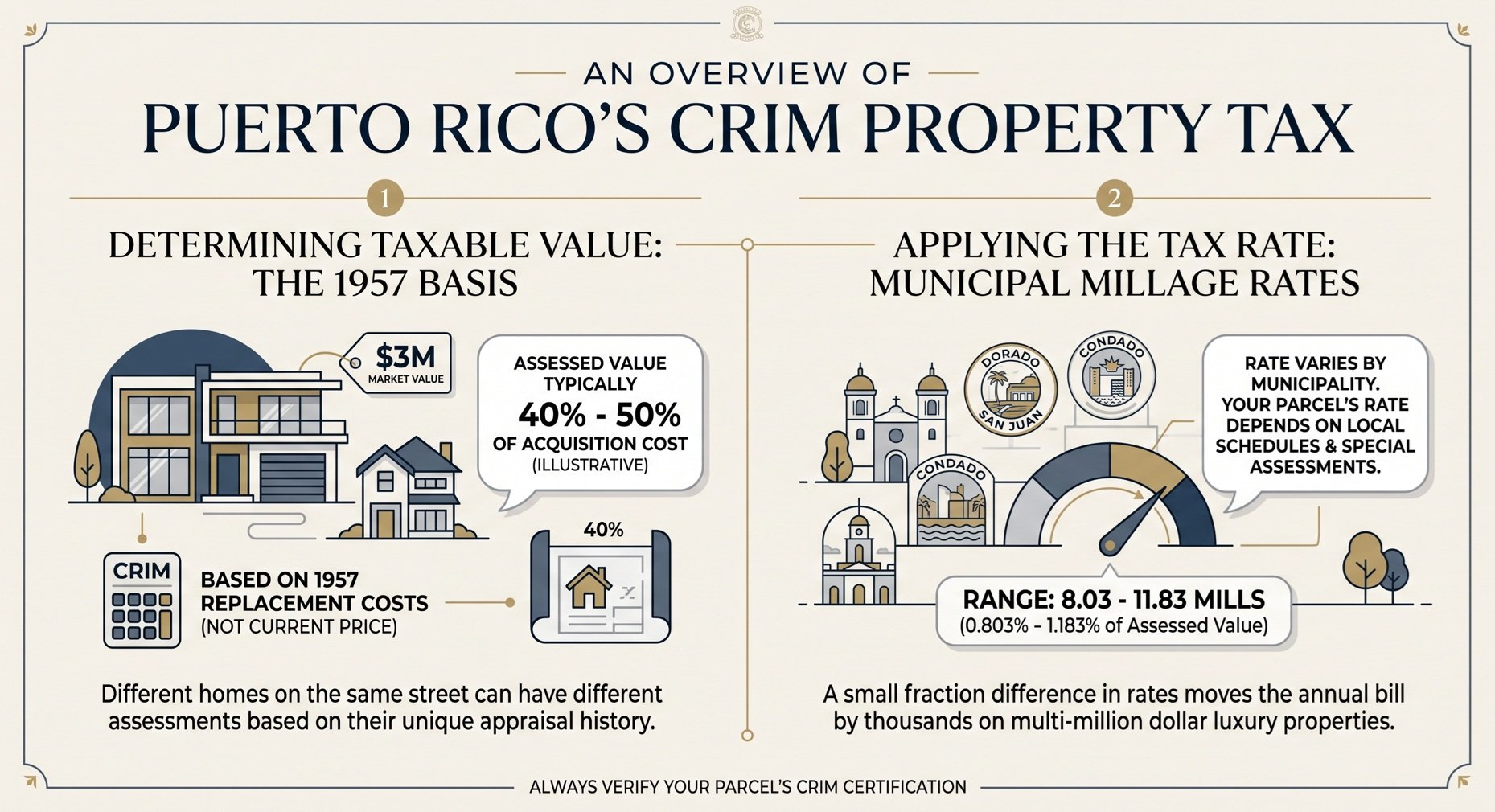
Puerto Rico's property tax authority, CRIM, calculates the taxable value of a home using a replacement-cost methodology tied to 1957 figures, then applies a municipal millage rate to that number rather than to the sale price on your closing statement. This is the single most common source of confusion at the closing table, because nearly every mainland buyer expects the county assessor to use last year's comparable sales.
According to the Puerto Rico Fiscal Agency and Financial Advisory Authority (AAFAF), CRIM's assessed values often land at roughly 40 to 50 percent of a property's actual acquisition cost, a gap the Financial Oversight and Management Board has flagged as a reason the system generates less municipal revenue than comparable mainland markets.
The Practical Result
two similarly priced homes on the same street can owe very different CRIM amounts, because each parcel's assessment reflects its own appraisal history layered onto the 1957 base. Buyers accustomed to Florida or New York — where the assessed value tracks recent comparable sales — should not assume the same logic applies here.
For an older beachfront property, that lag can mean an assessment that is years — sometimes decades — out of step with current construction costs.
Municipal Millage Rates Run 8.03 to 11.83, and the Municipality You Buy In Matters
CRIM applies a millage rate, expressed in mills, to the assessed value it calculates, and that rate typically falls between 8.03 and 11.83 mills, or roughly 0.803 percent to 1.183 percent of the CRIM-assessed value depending on the municipality. Dorado and San Juan both fall within that band, but the exact rate assigned to a given parcel depends on the municipality's current millage schedule and any special assessments layered on top for municipal services.
What This Means Buying in Dorado vs. San Juan
Dorado: Rates sit within CRIM's published 8.03–11.83 mill range, though the municipality's specific figure should be confirmed on the current CRIM portal before you budget a carrying cost.
San Juan (Condado, Old San Juan): Also within the same statutory band, with the final number depending on the specific barrio and any municipal add-ons tied to services or infrastructure.
Across municipalities generally: The rate difference between two towns is usually a fraction of a percentage point, but on a $3M or $5M assessed base that fraction still moves the annual bill by thousands of dollars.
A better rule of thumb: never assume a rate based on a neighboring town's number. Pull the specific millage figure for the parcel in question, or ask your Christie's PR specialist to request it from the seller's most recent CRIM bill.
Sample Municipal Millage & Components
Rates differ by municipality and are made up of several components (redemption fund, municipal fund, supervision fund, pension fund). The table below shows typical combined percentages for selected municipalities so you can compare at a glance. Use this as a reference only—confirm the current year’s figure with CRIM or your municipal office before budgeting.
MUNICIPALITY | REDEMPTION FUND (%) | MUNICIPAL FUND (%) | MUNICIPAL SUPERVISION FUND (%) | SPECIAL FUND FOR PENSION PAYMENTS (%) | STATE TOTAL COMBINED (%) | MUNICIPAL TOTAL COMBINED (%) | STATE TAX (‰) | MUNICIPAL TAX (‰) |
Aguadilla | 1.03 | 1.03 | 2.00 | 6.00 | 10.06 | 10.06 | 8.03 | 8.03 |
Cabo Rojo | 1.03 | 1.03 | 4.00 | 7.00 | 12.06 | 12.06 | 9.33 | 9.33 |
Culebra | 1.03 | 1.03 | 2.00 | 6.00 | 10.06 | 10.06 | 7.78 | 7.78 |
Dorado | 1.03 | 1.03 | 4.00 | 8.00 | 12.06 | 13.03 | 9.33 | 10.03 |
Isabela | 1.03 | 1.03 | 2.50 | 6.50 | 11.06 | 11.56 | 8.53 | 9.03 |
Ponce | 1.03 | 1.03 | 4.50 | 7.50 | 12.06 | 13.06 | 9.33 | 10.33 |
Rincón | 1.03 | 1.03 | 2.00 | 7.00 | 10.06 | 10.06 | 7.78 | 7.78 |
Río Grande | 1.03 | 1.03 | 3.75 | 8.75 | 11.81 | 12.53 | 9.03 | 9.78 |
San Juan | 1.03 | 1.03 | 3.75 | 9.75 | 12.56 | 14.53 | 9.78 | 11.53 |
Vieques | 1.03 | 1.03 | 3.00 | 7.00 | 11.03 | 11.03 | 8.53 | 8.53 |
Note: Figures are compiled by component and shown as both % and ‰ (mills). 1 mill = 0.1%. Verify current rates with CRIM; components and totals may change by fiscal year.
The $15,000 Primary Residence Exemption Barely Moves the Needle on a Luxury Purchase

Puerto Rico law exempts owner-occupants from paying property tax on the first $15,000 of CRIM's 1957-basis valuation for one principal residence, provided the owner requests the exemption from CRIM and does not rent the property — a benefit that matters far less on luxury properties in Puerto Rico than on modestly valued homes.
Some older summaries reference a $150,000 figure — that amount was a temporary bump under Ley 83-1991 that applied only to fiscal years 2009–10 through 2011–12 and has since expired. The standing exemption is $15,000, carried into the current Código Municipal de Puerto Rico (Ley 107-2020).
Who qualifies for the exemption, and who doesn't
Only owner-occupied primary residences qualify. A second home, a rental unit, or a vacation property held alongside a primary home does not.
One exemption per taxpayer. A family with a primary home in Dorado and a second unit in Condado can only claim it on one parcel.
The exemption is not automatic. It must be affirmatively requested from CRIM — usually at closing when financed, or by separate filing when purchased in cash.
Any rental use disqualifies the residence from the benefit.
This affects any owner holding more than one Puerto Rico property, since only the primary residence qualifies.
What $1M, $3M, and $5M Homes Actually Owe CRIM Each Year
Using CRIM's published methodology and AAFAF's guidance that assessed values often run 40 to 50 percent of acquisition cost, the table below models an estimated CRIM taxable assessment at the midpoint of that range, then applies the published 8.03–11.83 mill rate band.
Note: Illustrative figures only. Actual CRIM taxable assessments depend on each property's specific 1957-basis appraisal history — pull the CRIM certification for the parcel in question before relying on any number below for budgeting.
The exemption savings stay flat across price points because the benefit is capped at a fixed dollar amount of assessed value, not a percentage of the bill. Even under the higher figure some sources cite, the exemption is not a material factor in the carrying cost of a multi-million-dollar residence — high-net-worth buyers should verify the current amount with a licensed PR CPA but should not weight it heavily in a purchase decision.
Puerto Rico's Property Tax Load Looks Nothing Like New York or New Jersey

Relocating buyers from the Northeast and California consistently ask how Puerto Rico's real estate taxes stack up against what they are leaving behind, and the honest answer is that the island's system runs materially lighter on a percentage basis. Effective property tax rates reported by the U.S. Census Bureau's American Community Survey and commonly summarized by tax policy researchers put New Jersey and New York among the highest effective rates in the country, often in the 1.4 to 2.2 percent range of market value, while Florida and Miami-Dade generally run under 1 percent (U.S. Census Bureau, ACS data, accessed October 2026). Puerto Rico's CRIM system, applied to a 1957-basis assessment rather than market value, tends to produce an even smaller share of actual property value paid annually.
These mainland figures are approximate, vary meaningfully by county and by data year, and should be confirmed against current Tax Foundation state rankings or the specific county assessor's published effective rate before comparing directly to a Puerto Rico closing. Search "Tax Foundation state and local property tax collections" for the current live ranking page.
Act 60 Decrees Do Not Erase Your CRIM Bill, and LLC Ownership Does Not Change the Rate
Two questions come up in almost every consultation with relocating investors: does Act 60 cover the primary residence, and does an LLC change the rate.
Act 60 and Your Primary Residence
Act 60 incentives administered by Puerto Rico's Department of Economic Development and Commerce (DDEC) primarily address income tax, capital gains, and dividends for qualifying individuals and export-services businesses. They generally do not exempt a personal residence from CRIM property tax.
Act 60 property tax exemptions apply in specific, limited scenarios tied to business real property, not to a private residence. Decree holders should have their individual grant reviewed by a licensed Puerto Rico tax professional before assuming any CRIM exposure has been waived on a personal home.
Buying Through an LLC
CRIM assesses the property itself, not the entity that holds title. Whether a buyer closes in their own name or through an LLC, the municipal millage rate and the 1957-basis assessment methodology apply the same way. Ownership structure affects other tax matters, including federal income tax treatment and FIRPTA withholding on a future sale, but it does not change the CRIM property tax bill itself.
Four Things That Catch Relocating Buyers Off Guard at Closing

Across closings in Dorado, Condado, and Old San Juan, a handful of surprises come up often enough to call out directly.
They expect an annual reassessment. Many buyers from states with annual market-value reassessments are surprised that a Puerto Rico property can carry the same CRIM assessment for years, sometimes with no adjustment at all after a renovation.
They forget to register for the exemption. The primary residence exemption is not automatic. We routinely remind clients to file the CRIM registration property Puerto Rico paperwork within the first year of ownership.
They assume the seller's bill is a preview of theirs. A change in ownership can prompt CRIM to review the file, and a buyer should never budget off the prior owner's tax bill without independent confirmation.
They underestimate municipal add-ons. Some municipalities layer additional charges for services on top of the base millage, a detail worth asking about before you finalize a carrying-cost projection.
The right pre-offer step is to walk the buyer through these issues in detail and connect them with a licensed Puerto Rico CPA before closing rather than estimating figures internally.
How to Register a Property With CRIM and Claim the Exemption
Confirm the property's current CRIM account number and outstanding balance before closing, ideally through your title company or attorney. Account status can be checked directly on the CRIM taxpayer portal.
Record the deed and update ownership information with CRIM promptly after closing.
File the primary residence exemption request directly with CRIM if the home will serve as your principal dwelling and will not generate rental income.
Retain confirmation of the exemption filing, since it must be requested affirmatively and is not applied automatically.
Review your first CRIM bill under new ownership with a licensed Puerto Rico CPA to confirm the assessment and rate applied match what was disclosed at closing.
A qualified buyer's agent will handle this checklist alongside the closing timeline rather than leaving it as an afterthought after keys change hands.
Conclusion
Puerto Rico's property tax system rewards buyers who ask specific questions before closing rather than assuming mainland rules apply. Confirm the actual CRIM assessment and millage rate for the parcel, file the primary residence exemption if it applies, and have a licensed Puerto Rico CPA review the numbers before you build them into your budget. Reach out through our contact page to connect with a specialist and a reviewing CPA before your next offer.
Christie's International Real Estate Puerto Rico helps buyers, sellers, and renters navigate luxury properties in Dorado, Bahia Beach, Condado, Palmas del Mar, Rincón, and Old San Juan with parcel-level tax and closing diligence. Reach out through our contact page to speak with a specialist before your next offer.
FAQs
When are CRIM property taxes due, and what happens if they’re late?
CRIM bills are typically issued on a semiannual cycle. Note that public sources disagree on the specific months — some cite September/March, others January/July — so the definitive dates for a given parcel should be confirmed on the current CRIM bill or through the CRIM taxpayer portal. Late payments can trigger interest, surcharges, and collection actions.
Can renovations or new construction change my CRIM assessment?
Yes. Permitted improvements, expansions, or new construction can lead CRIM to update the property record and adjust the assessed value, which may increase the tax bill. Ask your attorney or CPA to review how planned work could affect the CRIM file.
How do I verify the CRIM account details before closing?
Request a CRIM certification (or equivalent account status document) showing the property’s account number, registered owner, assessed value, millage, and any outstanding debt. Have your title company/closing attorney match it to the deed and require proof any arrears are paid at closing.