Flipping a house in Puerto Rico can work when the purchase price, renovation scope, permits, carrying costs, and resale assumptions are tested against one property and one micro-market. It is not a guaranteed-return strategy, and luxury projects can magnify both the opportunity and the cost of mistakes.
This 2026 guide explains how to flip a house in Puerto Rico with a disciplined budget, verified approvals, qualified local advisers, and a realistic exit plan.
Key Takeaways
- Profit depends on a property-specific budget, not a national average or promised return.
- The 70% rule is only an initial screening formula and does not replace a full feasibility analysis.
- Title, approved plans, construction permits, condition, and intended use should be verified before contractual protections expire.
- Renovation budgets should include professional fees, permits, freight, financing, insurance, utilities, taxes, contingency, and selling costs.
- Tax and entity treatment depends on the facts; repeated flips may produce ordinary business income rather than capital gain.
Is Flipping a House in Puerto Rico Profitable?

A flip is potentially profitable only when the conservative resale proceeds exceed every acquisition, renovation, financing, holding, tax, and selling expense. There is no reliable island-wide profit percentage or completion timeline that applies to every project.
Build a Property-Specific Profit Model
Start with recent, relevant transactions for comparable renovated properties in the same micro-market. Reduce the expected resale price for differences in size, condition, view, parking, flood exposure, permits, and finish level, then test a lower-price and longer-hold scenario.
A practical worksheet should include the purchase price, closing costs, design and engineering, construction, permits, utility work, insurance, interest, property taxes, maintenance, marketing, brokerage, and a contingency tied to known risks. Keep optional upgrades separate from repairs needed to make the property safe, functional, and marketable.
Use the 70% Rule as a Screening Tool
The common formula is maximum purchase price = 70% of after-repair value (ARV) minus estimated repair costs. Treat it as a quick filter, not a guarantee: the percentage may not cover Puerto Rico-specific freight, approvals, financing, insurance, taxes, selling expenses, or the larger carrying costs of luxury real estate.
How to Flip a House in Puerto Rico
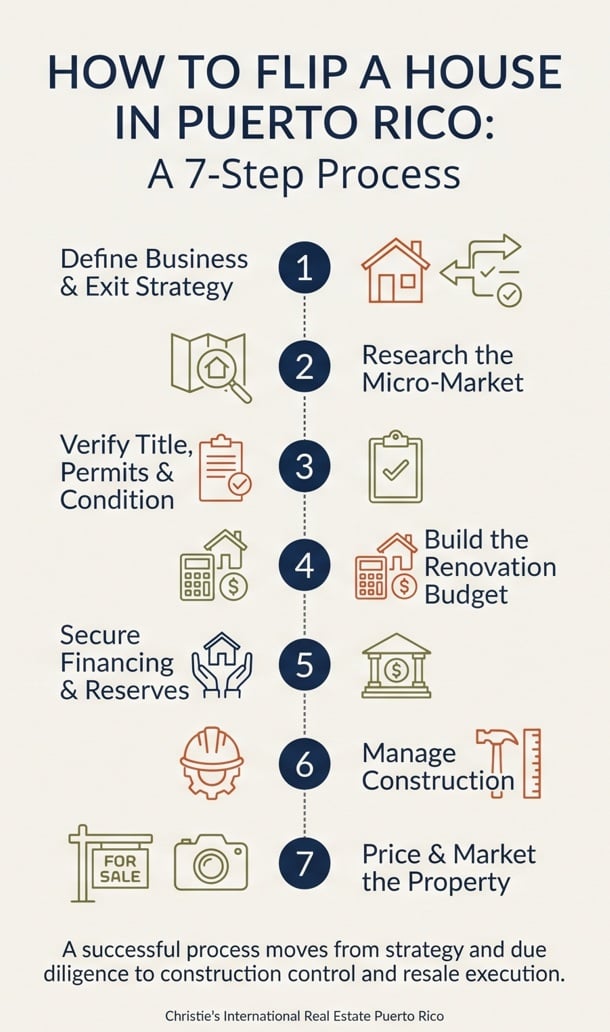
A successful process moves from strategy and due diligence to construction control and resale execution. Each step should produce written evidence that can be reviewed before more capital is committed.
1. Define the Business and Exit Strategy
Decide whether the project is intended for resale, rental, or another exit before choosing the property. Entity selection is not one-size-fits-all; a Puerto Rico attorney and tax professional should assess ownership, liability, financing, reporting, and U.S. and Puerto Rico tax consequences.
2. Research the Micro-Market
Compare recent transactions, current competition, typical buyer expectations, and days on market within the specific neighborhood and price band. San Juan, Dorado, Guaynabo, Palmas del Mar, and western coastal communities are not interchangeable markets, and a renovation that fits one buyer pool may be overbuilt for another.
3. Verify Title, Permits, and Property Condition
Have qualified professionals review title, surveys, approved plans, permit history, physical condition, flood exposure, utilities, and any condominium or community restrictions. The guide to unapproved additions explains why visible improvements, CRIM records, or active utilities do not replace permit verification.
4. Build the Full Renovation Budget
Ask contractors to price the same drawings and written scope, with exclusions and allowances clearly identified. Include roof and waterproofing, concrete repair, electrical and plumbing systems, windows and doors, backup power, cisterns, landscaping, pools, imported materials, professional fees, and change-order risk where relevant.
5. Secure Financing and Reserves
Compare the total cost and conditions of available financing rather than focusing only on the interest rate. Account for appraisal requirements, draw schedules, fees, personal guarantees, insurance, extension charges, and enough liquidity to absorb delays or discoveries without forcing an unfinished sale.
6. Manage Construction and Change Orders
Use a written schedule, milestone inspections, documented payments, and change orders that show scope, price, and time effects before work proceeds. Verify contractor credentials and require the architect, engineer, or other appropriate professional to review work within the agreed scope.
7. Price and Market the Finished Property
Set the price from current comparable evidence after the renovation, not from the original projection. Professional photography, accurate disclosures, complete records, and a local sales strategy can help buyers understand the completed work without relying on unsupported investment promises.
Puerto Rico Permits, Added Units, and Change-of-Use Risks

Remodeling, adding living area, converting a garage, or changing a property's use may require approvals that affect both cost and timing. The official OGPe portal directs new construction and remodeling projects to the applicable permit process and licensed professionals.
Existing Unpermitted Work
Do not assume undocumented work can be approved later or simply included in ARV. Request the available plans and case records, compare them with existing conditions, and have qualified advisers identify the responsible authority, possible remedies, and transaction risk.
Adding or Converting a Unit
A detached unit, garage conversion, or divided residence should not be treated as a generic “ADU” opportunity without confirming permitted use, density, parking, utility, building, fire, and other property-specific requirements. Separate the value of legally usable space from an unverified income projection.
Coastal, Flood, and Historic-Area Constraints
Coastal setbacks, flood requirements, environmental review, historic-preservation controls, or community design rules can change the feasible scope. Identify these constraints during acquisition review, not after design or demolition begins.
Taxes and Business Registration

House-flipping tax treatment depends on why and how the property is held, the frequency and continuity of sales, and the taxpayer's broader activities. Obtain Puerto Rico and U.S. tax advice before relying on an incentive, entity, or capital-gain assumption.
Flipping Profit May Be Ordinary Business Income
IRS Publication 544 explains that property held mainly for sale to customers in a trade or business is not a capital asset. A short holding period does not by itself settle the analysis, and a flip should not automatically be described as a short-term capital gain.
Register the Business and Tax Accounts Correctly
Puerto Rico's SURI guidance identifies online functions such as registering business locations and obtaining a Merchant Registration Certificate. Confirm the applicable entity, municipal, tax, permit, employment, and reporting requirements with qualified advisers before operating.
Common House-Flipping Risks
Risk management starts by assigning a cost, deadline, and responsible professional to each major uncertainty. These issues should be reflected in the acquisition decision and contingency, not treated as surprises after closing.
- Unsupported ARV: renovated comparables may differ materially from the subject property.
- Hidden condition issues: moisture, concrete deterioration, roof, electrical, plumbing, or drainage work can expand the scope.
- Permit delays: the proposed design or existing work may require additional review or correction.
- Financing and carrying costs: interest, insurance, utilities, taxes, security, and maintenance continue while the project is delayed or marketed.
- Over-improvement: premium finishes do not automatically produce an equal increase in resale value.
- Tax misclassification: entity choice or residency does not automatically convert flipping profit into exempt or capital-gain income.
Puerto Rico Luxury Properties for Sale
Current listings can help investors study redevelopment potential, finish standards, and buyer expectations, but they are not guaranteed flip opportunities or resale benchmarks. These four luxury properties for sale illustrate different locations and project profiles. Verify availability, condition, permitted use, and feasibility before making an offer.
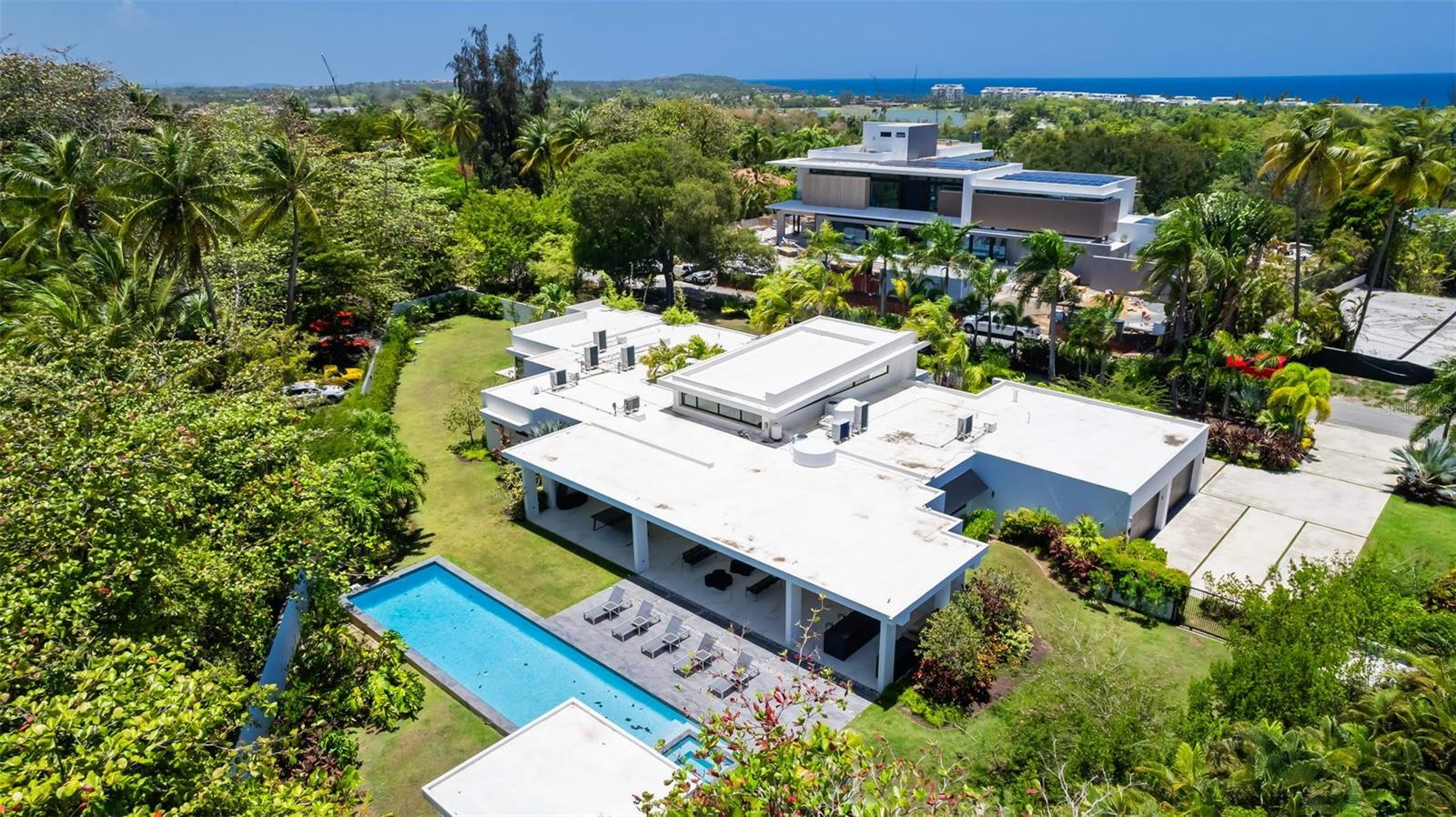
1 Dorado Beach Estates, Dorado, PR 00646
This active listing includes four bedrooms, six bathrooms, and 8,500 square feet of listed interior area in Dorado Beach Estates. Built in 2021, it features a 60-foot pool, outdoor kitchen, and four-car garage.

20 Amapola Street, Carolina, PR 00979
This active Isla Verde beachfront listing includes six bedrooms, six bathrooms, and 6,590 square feet in the listing summary. The description identifies an approximately 1,790-square-meter lot and presents the existing structure as a renovation or redevelopment opportunity.

9 Castaña Street, Guaynabo, PR 00968
This active San Patricio listing offers seven bedrooms, ten bathrooms, and 10,000 square feet on a 1.2-acre site. Listed features include a pool, outdoor kitchen, basketball court, private gym, backup generators, and a 6,000-gallon cistern.

12 and 13 Roble Valley, Humacao, PR 00791
This active Palmas del Mar listing combines a five-bedroom, six-bathroom residence with an adjacent lot and 5,000 square feet of listed interior area. The property includes a pool, solar panels, three Tesla Powerwalls, a generator, and a rainwater cistern.
Conclusion
A sound Puerto Rico house flip begins with evidence: a supportable ARV, documented property condition, verified approvals, and a complete cost model. Treat screening formulas and tax incentives as questions to test, not promises of profit. Keep enough time and capital available to respond when due diligence or construction changes the plan.
If you are looking to buy, sell, or evaluate Puerto Rico luxury properties, Christie's International Real Estate Puerto Rico can provide knowledgeable local guidance. Contact our team to discuss your preferred location, property type, and real estate goals.
FAQs
Is Puerto Rico Good for Flipping Houses?
Puerto Rico can offer viable projects, but profitability depends on the specific property, neighborhood, acquisition basis, permitted scope, financing, and resale demand. Use conservative comparable evidence and independent professional review rather than an island-wide return claim.
What Is the 70% Rule for Flipping a House?
It is a preliminary formula that subtracts estimated repairs from 70% of projected ARV to produce a screening purchase price. It does not automatically cover Puerto Rico-specific professional fees, permits, freight, taxes, financing, insurance, carrying costs, or selling expenses.
Do House Renovations in Puerto Rico Need Permits?
Requirements depend on the property, location, and scope of work. OGPe advises using a licensed architect or engineer for new construction and remodeling permit processes, while qualified professionals should confirm whether any work is exempt or subject to another authority.
Is House-Flipping Income a Capital Gain?
Not necessarily. Property held mainly for sale to customers in a trade or business is generally not a capital asset for U.S. federal tax purposes, and Puerto Rico treatment also requires fact-specific professional advice.
Related Articles
Continue with these guides on permits, renovation feasibility, and investment tax planning in Puerto Rico.